Dahlia Diary
When to Dig Up Dahlia Tubers & Store Them for Winter
Dahlias are tender perennials — their tubers survive winter only where they never freeze. Here is when to dig them, which zones actually need to, and how to store them so they come out of winter plump, firm, and ready to sprout.
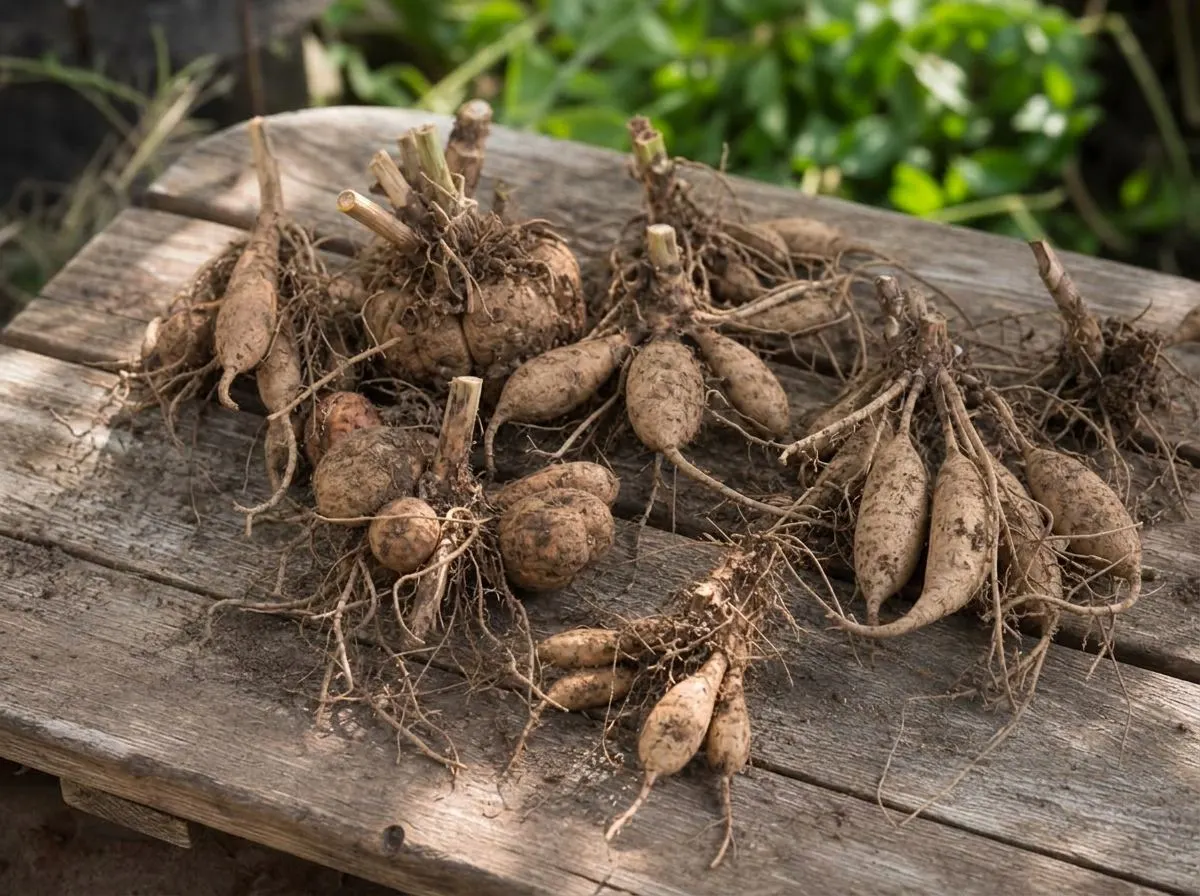
Do you have to dig up dahlia tubers every fall?
One of the most common questions new dahlia growers ask is surprisingly hard to answer with a simple yes or no. If you garden where the ground freezes deeply, the safest answer is yes.
Dahlias are tender perennials. Their underground tubers survive from year to year where they are protected from freezing, but unlike hardy bulbs such as daffodils and tulips, dahlia tubers can be killed outright when they freeze. The American Dahlia Society recommends storing tubers somewhere cool but above freezing — ideally around 40–45°F.
That doesn't mean every gardener in every climate has to lift them. In warmer parts of the country dahlias often stay in the ground all winter, and there is a middle ground where overwintering outdoors works but comes with real risk. The deciding factors are your USDA hardiness zone, winter temperatures, soil drainage, and local conditions. (If you're still wondering whether dahlias come back at all, start with Are dahlias perennials?)
What zones need to dig up dahlia tubers?
- Zones 3–6 — yes. Dig and store indoors.
- Zone 7 — usually recommended. In-ground overwintering can work with excellent drainage and heavy winter protection, but lifting is safer.
- Zone 8 — usually optional. Tubers often overwinter in well-drained soil under mulch.
- Zones 9–10 — usually not necessary, provided the soil doesn't stay waterlogged.
- Zone 11 and warmer — winter cold generally isn't the limiting factor, though local growing cycles differ.
This is intentionally conservative. North Carolina State Extension lists dahlias for Zones 7–10 and advises growers below Zone 7 to lift, noting indoor storage as an option even in Zone 7 and simple mulching in Zone 8. Oregon State takes a broader view and says growers in Zone 7 or warmer may overwinter dahlias in the ground with proper protection.
That doesn't make Zone 7 automatically safe. It makes Zone 7 borderline. If you have an expensive, rare, or sentimental dahlia, the zone number alone is not a good reason to risk it.
USDA zone is only part of the story
Hardiness zones are based on average annual extreme minimum winter temperature. They don't tell you how wet your soil stays in January, whether you have heavy clay, how deeply the soil freezes, how often temperatures cycle above and below freezing, how much insulating snow you get, or whether a plant sits beside a warm foundation on a protected southern exposure.
Those differences explain why one Zone 7 gardener overwinters dahlias successfully year after year while another loses nearly everything. The Royal Horticultural Society notes dahlias have a much better chance outdoors in lighter, free-draining soil; heavy soils stay colder and wetter and raise the risk of tuber rot. So ask two questions: how cold does my soil get, and how wet does it stay?
A conservative rule
- Zones 6 and colder: dig it.
- Zone 7: consider digging, especially if it's valuable.
- Zone 8: leaving it in is usually fine with good drainage; lift irreplaceable stock.
- Zones 9+: cold isn't the reason to lift, but poor winter drainage can still rot tubers.
There's no prize for proving a dahlia could survive outside. If you have one tuber of a cultivar you desperately want to keep, frost-free storage removes most of the gamble.
When should you dig up dahlia tubers?
Here's another common myth: you do not have to dig dahlias the moment the first frost touches the leaves. Letting plants grow late into the season actually helps the tubers mature. The American Dahlia Society notes dahlia roots keep developing late in the season, and the longer mature plants can stay in the ground under suitable conditions, the better developed the storage tubers become.
For most home gardeners the signal to start thinking about digging is the first killing frost. You'll know it when you see it — the green dahlia patch looks completely different the next morning, with dark, limp, blackened leaves and the flowering season over.
Should you wait until after the first frost?
Generally yes, if your weather allows it. Waiting lets you enjoy every last flower while the tubers mature. But frost is not required to make a tuber viable — Penn State Extension specifically notes tubers don't have to experience frost before being dug; their Zone 5b example waits mainly to extend the flowering season.
There are perfectly good reasons to dig early:
- A hard freeze is approaching
- Prolonged heavy rain is forecast, or your soil gets very wet in fall
- You have hundreds of plants to process
- You're leaving town
- The plants have simply finished their season
The goal isn't to obey a date. The goal is to harvest mature tubers before freezing soil damages them.
Light frost vs. hard freeze
A light frost can damage flowers and foliage without freezing the soil around the tubers — that's usually not an emergency, since several inches of soil still protect the clump. A prolonged hard freeze is different. If freezing penetrates deeply enough to freeze the tubers themselves, they're destroyed; frozen tubers typically turn soft and rot as they thaw.
Oregon State advises digging after a hard frost has killed the stalks, and notes that if another freeze is imminent you can dig immediately rather than leaving tubers in the ground. In short: let the plant mature as long as practical, but never let the tuber clump freeze.
Should you wait a week or two after frost?
You'll hear every version of this advice — dig immediately, wait a few days, wait two weeks. There is no magic number; the limitation is weather. If the forecast reads 45°F, 42°F, 38°F, you have flexibility. If it reads 24°F, 20°F, 18°F, your priorities have changed. Protect the tubers.
How to dig dahlia tubers without breaking them
Dahlia clumps get surprisingly large by the end of the season, and freshly dug tubers are fragile. The most vulnerable part is the neck — the narrow section connecting each tuber to the crown. A fat, beautiful tuber with a broken neck is useless once it's separated from the crown and its viable eye. So never pull a dahlia out of the ground by its stem.
Step 1: Label before you cut anything down
This sounds too obvious to mention — until you're looking at a pile of 30 brown clumps that all look identical. The American Dahlia Society recommends confirming cultivar labels before frost and keeping the identification physically attached to the clump through digging and processing. Once the foliage and flowers are gone, your visual ID system is gone with them.
Step 2: Cut back the stalk
After frost ends the season, cut the stalk down, leaving about 4–6 inches as a handle. Don't leave a long hollow stem exposed to the weather for long: dahlia stalks are hollow and water travels down inside them toward the crown, which the ADS warns can cause crown rot. If you cut plants and leave them in the ground for several days, cover the open stalks from rain.
Step 3: Start digging well away from the stem
Don't put your shovel right beside the stalk — a mature clump spreads much farther than you expect. The ADS suggests loosening the plant from all sides, roughly a foot out from the central stalk, before lifting from underneath. A garden fork works well too. The goal is to loosen the whole root zone, not spear the tubers.
Step 4: Lift the whole clump
Work your fork or shovel underneath the root mass and lift carefully from below. Don't grab the stem and yank — freshly dug necks are brittle, and one aggressive pull turns a beautiful clump into a pile of broken tubers.
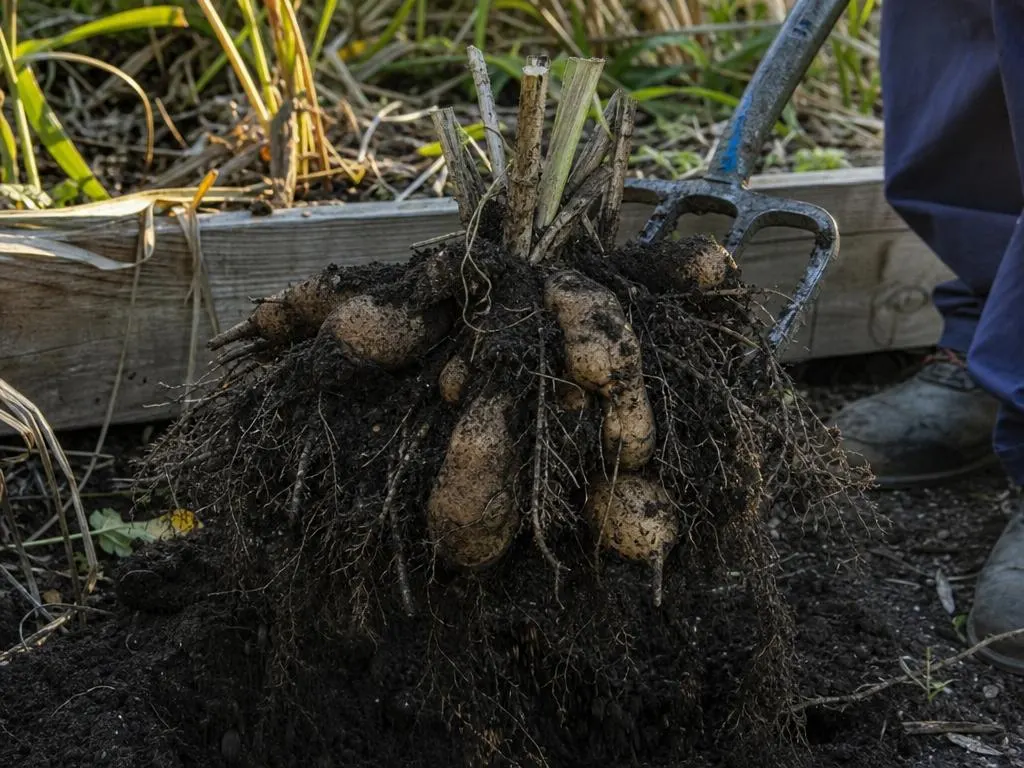
Turn the clump upside down after digging
Because dahlia stems are hollow, water stays trapped inside the stalk after cutting or washing. Flip clumps upside down for a while so moisture drains away from the crown. Both RHS and ADS guidance stress draining moisture before winter storage — crown rot can destroy an entire clump, and a little attention now saves a favorite cultivar later.
Should you wash dahlia tubers before storage?
Experienced growers genuinely disagree here, and both camps store dahlias successfully.
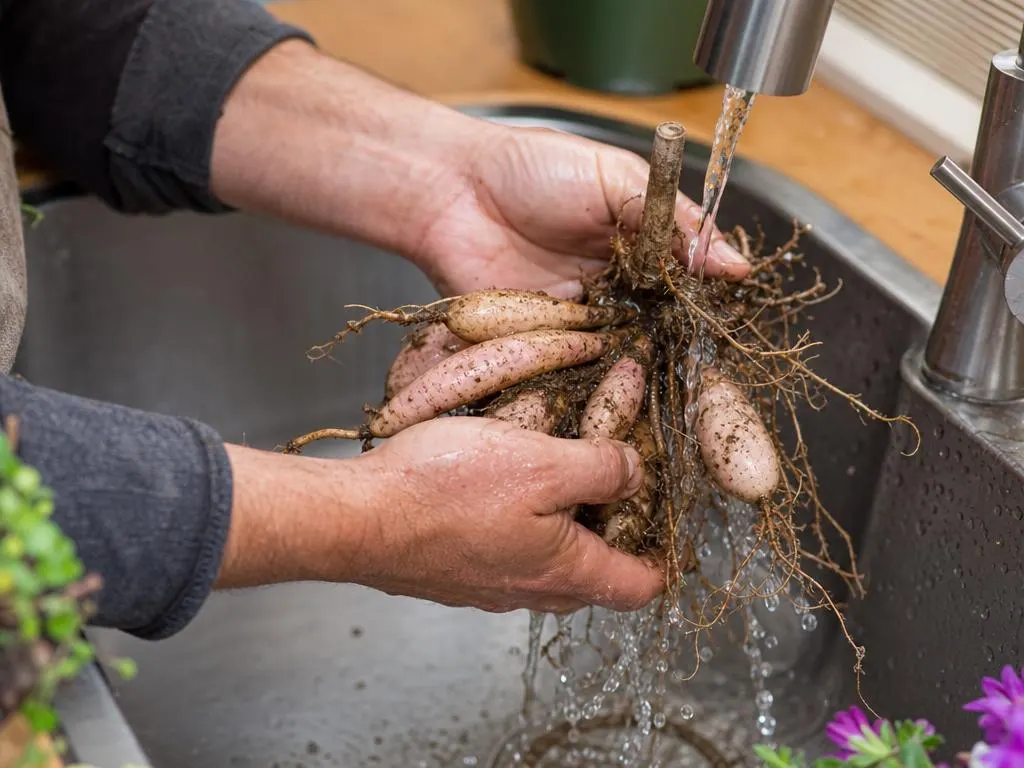
Washing lets you inspect for damage, spot disease or rot, divide more easily, label individual tubers, and store cleaner material. The ADS describes washing tubers thoroughly before division and storage.
Leaving soil on intact clumps also works. Penn State notes intact clumps can be stored without washing off all the soil, although they take considerably more storage space.
What is not optional: do not put wet tubers into winter storage. If you wash them, give the surfaces time to dry before packing.
Should you divide dahlia tubers in fall or spring?
Another question with two correct answers.
- Fall division: fresh clumps are easier to cut and division dramatically reduces storage space. The downside is that eyes are hard to see.
- Spring division: over winter the eyes become much easier to identify, which makes spring especially friendly for beginners.
RHS takes the conservative approach and recommends leaving clumps intact until spring, since fresh cuts create extra entry points for storage rot. For beginners, storing smaller intact clumps and dividing in spring is a perfectly reasonable strategy.
The most important rule when dividing
A dahlia tuber needs an eye. A tuber can be enormous, beautiful, and perfectly healthy and still never grow without one. Eyes form near the crown where the tuber joins the old stem — not scattered over the whole tuber like a potato. University of Georgia Extension emphasizes that growth buds occur where the tubers connect to the underground stem; lose that connection and the tuber generally cannot produce a plant.
So don't judge a division by tuber size. You need tuber + intact neck + piece of crown + viable eye. If you're not sure what you're looking at, our photo walkthrough on how to identify an eye on a dahlia tuber shows obvious eyes, hard-to-spot pre-eyes, and non-viable tubers side by side.
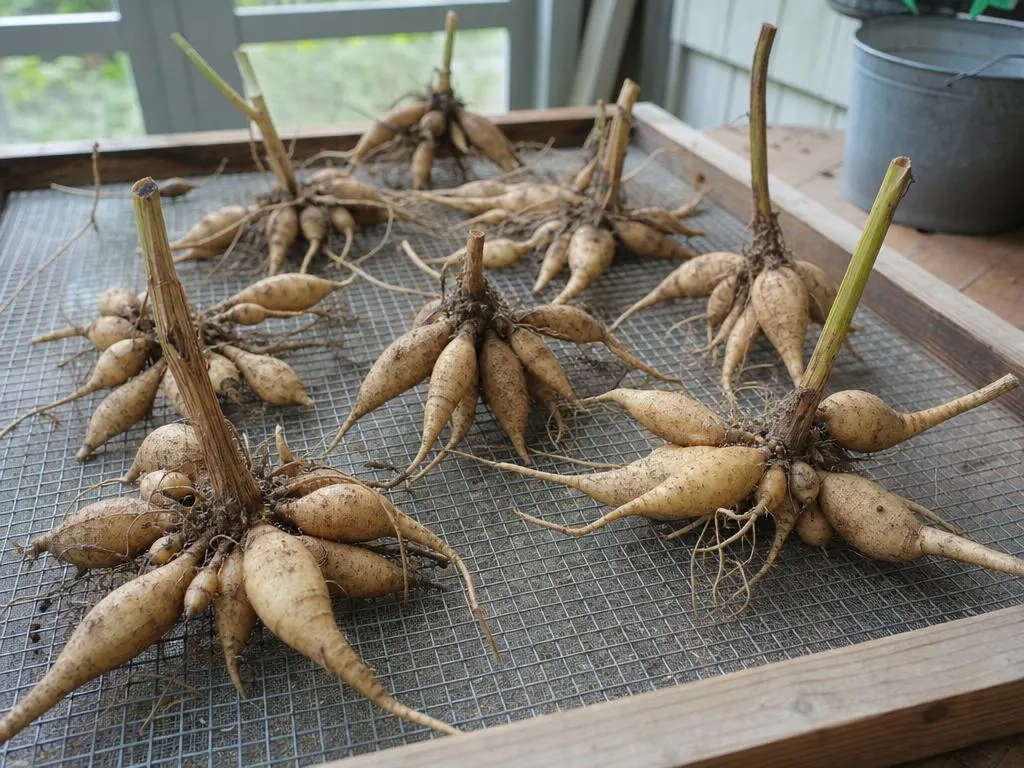
How long should dahlia tubers dry before storage?
Long enough that you aren't trapping surface moisture around them, but not so long that they dehydrate and shrivel. Think of it as drying off rather than prolonged curing.
The ADS commonly describes drying cleaned or divided tubers about one to two days before storage, depending on method; Oregon State similarly describes roughly 24 hours. Larger intact clumps stored by other methods may need a bit longer. What you want is a dry surface on a plump tuber — not a wet tuber, and not a wrinkled potato chip.
What temperature should dahlia tubers be stored at?
This is the single most important number in the article: 40–45°F.
The ADS commonly recommends roughly 40–45°F, with broader guidance to stay safely above freezing and below about 50°F. Oregon State recommends a location that will not freeze, with an ideal range near 34–40°F for its system, and University of Georgia suggests roughly 35–50°F. Don't obsess over a degree — think cold refrigerator temperatures, never frozen.
If tubers get too cold
Freezing damages cells inside the tuber. After thawing it turns soft, translucent, watery, mushy, rotten — and there's usually no saving it. This is why an unheated detached garage is not automatically safe in a northern climate. If the air inside drops below freezing in January, so do your tubers. Put a min/max thermometer in the space before trusting valuable stock to it.
If tubers are stored too warm
Warm storage brings a different set of problems: early sprouting, premature feeder roots, faster dehydration, and more fungal and microbial activity. The ADS notes warmer conditions encourage sprouts and feeder roots while favoring microorganisms. A 68°F finished basement is not ideal. You want cool dormancy, not spring growth in January.
Where can you store dahlia tubers?
- Cool basement
- Root cellar
- Insulated garage that reliably stays above freezing
- Cool utility room
- Temperature-controlled storage space
- A dedicated refrigerator with monitoring
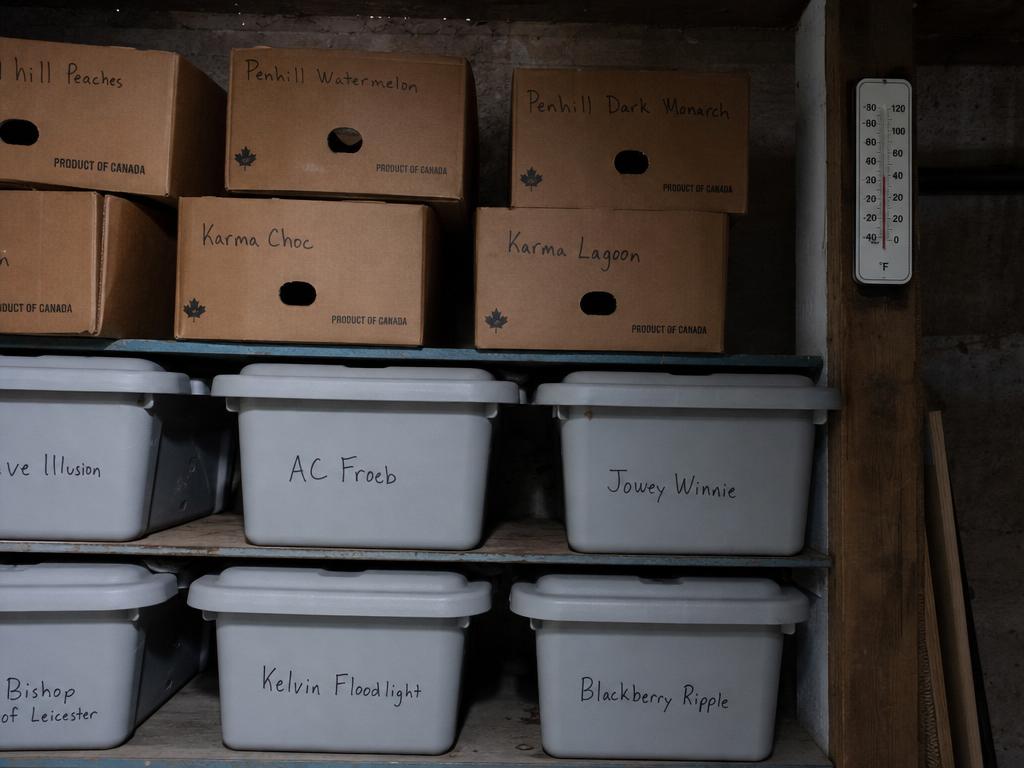
The best location isn't the fanciest — it's the one that stays consistently cool, frost-free, relatively dark, and stable. Temperature swings cause as much trouble as an imperfect but steady temperature.
What should you store dahlia tubers in?
There are almost as many storage methods as there are dahlia growers: coarse vermiculite, wood shavings, slightly damp packing material, newspaper, plastic wrap, or intact clumps. The medium matters less than the result — an environment that keeps the tuber from getting too wet or too dry.
Vermiculite
One of the best-known methods. The ADS describes placing dried tubers into plastic bags with coarse vermiculite, using enough medium to buffer moisture around the tubers, then holding them near 40–45°F. Coarse vermiculite moderates moisture well. The tuber should stay firm without sitting in a soggy medium — avoid making the vermiculite visibly wet.
Peat moss
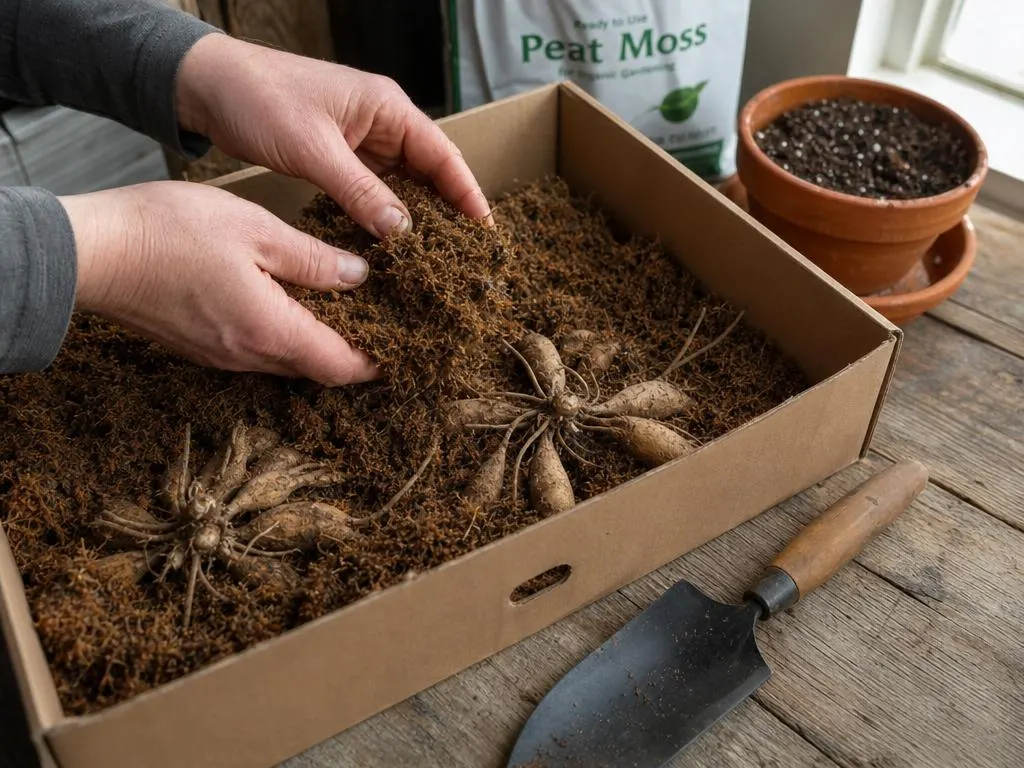
Plenty of older guides recommend peat, and it can work, but it's less forgiving than people realize. The ADS notes the common problem: very dry peat pulls moisture out of the tuber, while wet peat encourages rot. That makes moisture management critical, and for beginners coarse vermiculite or another easier-to-monitor method is usually simpler.
Plastic wrap
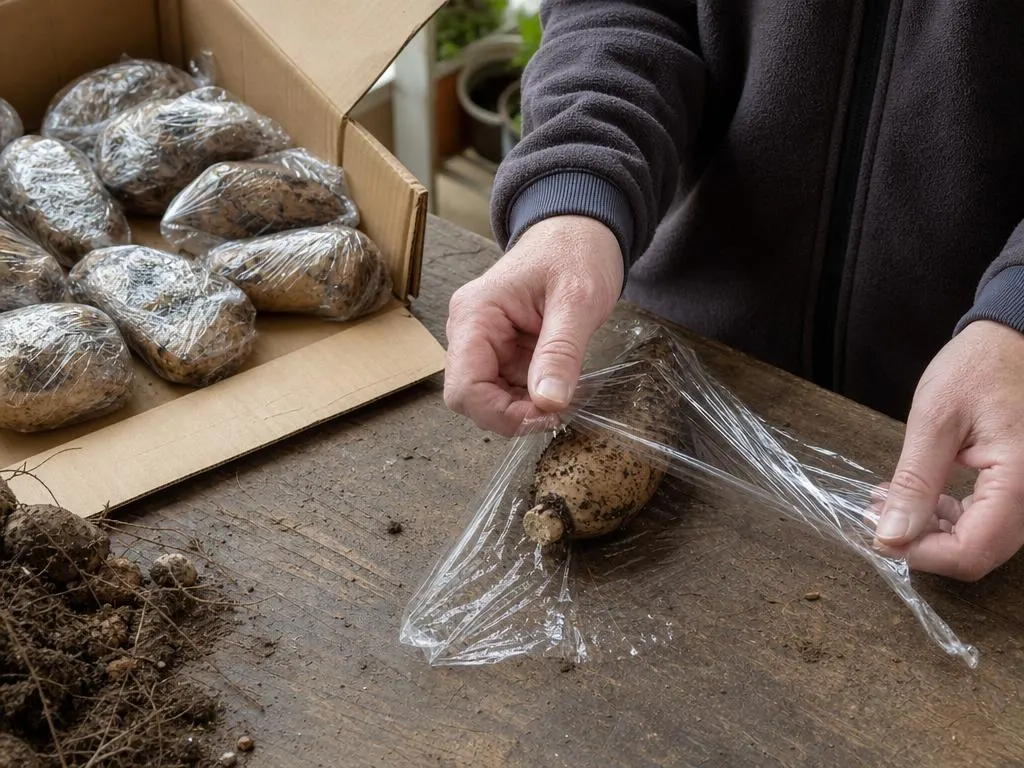
It sounds strange the first time you hear it, but it's an established technique. The ADS has published a plastic-wrap method in which individual dried, divided tubers are wrapped so they stay isolated from one another, then stored at roughly 40–45°F. It dramatically reduces dehydration and takes very little space. Proper drying first is essential — wrapping a wet or rotting tuber doesn't solve the moisture problem, it traps it.
Should containers be completely sealed?
It depends on your method and your ambient humidity, which is exactly why growers seem to contradict each other. A gardener in a dry heated basement is fighting dehydration; a gardener in a humid coastal garage is fighting rot. The ADS notes ventilation and airtightness may need to vary with tuber size and storage humidity — a far more useful rule than insisting on one perfect container.
Why do dahlia tubers shrivel in storage?
Shriveling means the tuber is losing too much moisture. A slightly wrinkled tuber may still grow; a severely dehydrated one is much less likely to. Common causes:
- Very dry room air
- Storage temperatures that are too warm
- Overly dry packing material
- Too much ventilation
- Storing thin tubers without moisture buffering
If your tubers turn into raisins by February, don't assume you harvested them wrong. Your storage environment is probably too dry.
Why do dahlia tubers rot in storage?
Rot is the opposite problem. Common contributors:
- Storing tubers while still wet
- Excessive moisture in the packing material
- Damaged, infected, or diseased tissue
- Temperatures that are too warm
- Condensation, or poor drainage around the crown before storage
- Freeze damage followed by thawing
If a tuber goes soft, remove it promptly. The ADS recommends inspecting stored tubers about monthly so rot is caught before it spreads to neighbors.
Check your tubers through winter
Don't pack the collection away in November and forget it until April. Check monthly and look for:
- Shriveling — environment too dry
- Condensation — too much moisture or big temperature swings
- Soft spots — possible rot
- Mold — remove affected material and reassess moisture
- Premature sprouts — storage too warm
- Frozen or translucent tissue — storage got too cold
Small corrections in December prevent a large loss by March.
Should you throw away a slightly shriveled tuber?
Not automatically. A tuber can look unimpressive by spring and still be alive. If it stays reasonably firm with a healthy crown and eye, give it a chance. Rot is more concerning than modest dehydration: a rotten tuber goes soft, while a dormant, slightly dehydrated one stays structurally firm.
What about dahlias growing in pots?
Container dahlias can be overwintered two ways: remove the clump and store it, or store the entire dormant pot somewhere cool and frost-free. The ADS describes both — whole pots can go dormant, protected from freezing and kept relatively dry until spring.
The critical part is that the pot must not freeze solid. Containers offer far less insulation than the ground, so a tuber that would survive under six inches of soil can freeze quickly in an exposed pot.
How to leave dahlia tubers in the ground over winter
If your climate makes outdoor overwintering reasonable, don't just walk away after frost. Oregon State recommends:
- Choose an area with excellent drainage
- Cut stems down after frost
- Protect the planting area from excessive winter moisture
- Apply at least several inches of organic mulch (RHS suggests about 6 inches)
- Remove the covering in spring once serious frost danger has passed
Match the method to your climate. In rainy regions, keeping water away from the crown matters as much as insulation.
Don't mulch too early
Wait until the soil starts cooling and the plant has gone dormant. Heavy mulch applied too early holds unnecessary warmth and moisture around the crown. The goal isn't to keep the dahlia growing all winter — it's to stabilize soil conditions and protect the dormant crown.
Heavy clay changes the equation
A Zone 8 garden with saturated clay can be riskier than a protected Zone 7 garden with excellent drainage. Tubers are fleshy storage organs, and months in cold, saturated soil encourage decay. RHS specifically names heavy winter soil as a reason indoor storage may be safer. If water stands in your dahlia bed after winter rain, don't rely on the zone map — lift valuable tubers.
Can snow protect dahlia tubers?
Snow insulates well, and a stable blanket keeps soil temperatures far more consistent than bare ground during extreme cold. But snow cover isn't reliable enough to be your primary strategy where dahlias aren't hardy. Some winters bring deep snow; others bring repeated freeze/thaw cycles with almost none. In Zone 5 or 6, hoping for snow to save a prized tuber is a high-risk experiment.
What about microclimates?
Microclimates are why you'll hear "I'm in Zone 6 and mine came back!" That absolutely happens. A dahlia beside a heated foundation, against a south-facing wall, under deep mulch, in exceptionally well-drained soil, with consistent snow cover, can experience soil temperatures very different from a plant 30 feet away. Survival is possible — but surviving one winter doesn't make a cultivar reliably hardy in that zone.
When should you take tubers out of storage?
Usually a few weeks before you plan to plant or start them indoors. As spring approaches, move tubers somewhere slightly warmer to encourage eyes to become visible — Oregon State suggests waking stored clumps around March or April by moving them into roughly 40–50°F. If you divide in spring, visible eyes make the job much easier.
Then wait for real planting weather. Dahlias are frost-sensitive, and cold, wet soil is one of the fastest ways to lose a newly planted tuber. Our zone-by-zone guide to when to plant dahlia tubers gives target dates for your area. Don't water heavily right after planting either — until active growth begins, the tuber holds all the energy the plant needs, and excess moisture invites rot.
The biggest dahlia storage mistakes
- Letting tubers freeze — the fastest way to lose a whole collection. Know your storage area's real minimum temperature.
- Storing wet tubers — surface moisture plus cold storage invites rot.
- Drying them too much — dahlias aren't bulbs with hard skins; dry them off, don't leave them in a heated room for weeks.
- Storing them too warm — encourages sprouting, dehydration, and microbial activity. Aim for 40–45°F.
- Forgetting labels — label as you dig, not later.
- Breaking necks — lift from beneath and handle newly dug tubers gently.
- Saving diseased plants — storage isn't a hospital. The ADS recommends discarding poor or virus-suspect stock rather than carrying it into another season.
Quick dahlia winter checklist
- Zones 3–6: lift and store. Let the season finish, then dig before the clump can freeze.
- Zone 7: borderline. Outdoor overwintering may succeed in well-drained, protected spots with heavy mulch — but store important cultivars indoors.
- Zone 8: often fine outdoors with good drainage and winter mulch. Lift valuable cultivars if your soil stays cold and wet.
- Zones 9–10: usually leave in place. Winter wetness matters more than cold.
Frequently asked questions
Do dahlias have to be dug before the first frost?
No. Most growers wait until frost ends the flowering season. What matters is digging before freezing temperatures reach the tuber clump itself.
Do dahlias need frost before you dig them?
No. Frost is a convenient seasonal signal, not a biological requirement for tuber storage.
How cold can stored dahlia tubers get?
Keep them above freezing. A commonly recommended range is about 40–45°F.
Can I store dahlia tubers in my garage or basement?
Yes, if the garage reliably stays above freezing and doesn't get too warm, and if the basement is genuinely cool. A 65–70°F finished basement is not ideal. Monitor the actual temperature rather than assuming.
Should I divide dahlias in fall or spring?
Either works. Fall division saves storage space; spring division makes the eyes easier to identify. Beginners usually find spring easier.
Do I need to wash my dahlia tubers?
No single method is mandatory. Many growers wash divided tubers; others store intact clumps with soil on. Whatever you do, don't put wet tubers into enclosed storage.
How often should I check stored tubers?
About once a month is a good routine.
Digging dahlias isn't as complicated as it looks
The first year, the process feels intimidating. By the third year it's just another season in the garden. The formula is remarkably simple: grow them as long as practical, don't let the tubers freeze, dig carefully, let surface moisture dry, store around 40–45°F, prevent both rot and dehydration, and check them occasionally through winter.
When spring arrives and little eyes appear on a tuber you tucked away months earlier, you haven't just saved a root — you've saved an exact copy of the plant you loved last summer. That's the big difference between saving dahlia seeds and saving tubers: a seed is a genetic surprise, while a tuber preserves the dahlia you already know. (The genetics behind that is worth a read if you're curious, and dahlia forms, sizes & colors will help you decide what's worth keeping.)
Keep track of every tuber you store
A grower with 30 varieties easily ends up with 200+ tubers after fall division. Paper tags fade, spreadsheets get abandoned, and by March you're guessing what "the dark pink one in the peat box" actually is.
The BotaNotes Dahlia Diary is built for exactly this: log every tuber with a photo, the variety, the storage method, and the location, then filter by variety in spring to plan your beds and mark tubers as planted, sold, or gifted. Try the read-only demo or start your dahlia diary.
Sources & further reading
- American Dahlia Society — tuber storage recommendations
- Oregon State University Extension, Penn State Extension, North Carolina State Extension, University of Georgia Extension, and the Royal Horticultural Society — zone, digging, and storage guidance
- BotaNotes — Dahlia hub: variety guides, planting calendars, and tuber inventory
- BotaNotes — How to save dahlia seeds