Dahlia Diary
Dahlia Varieties: Flower Forms, Sizes & Colors Explained
There is no such thing as "a dahlia." There are roughly 20 recognized flower forms, six size classes and fifteen official color groups, and a variety name only means something once you know which combination it belongs to. This is how the system works and how to use it when you shop.
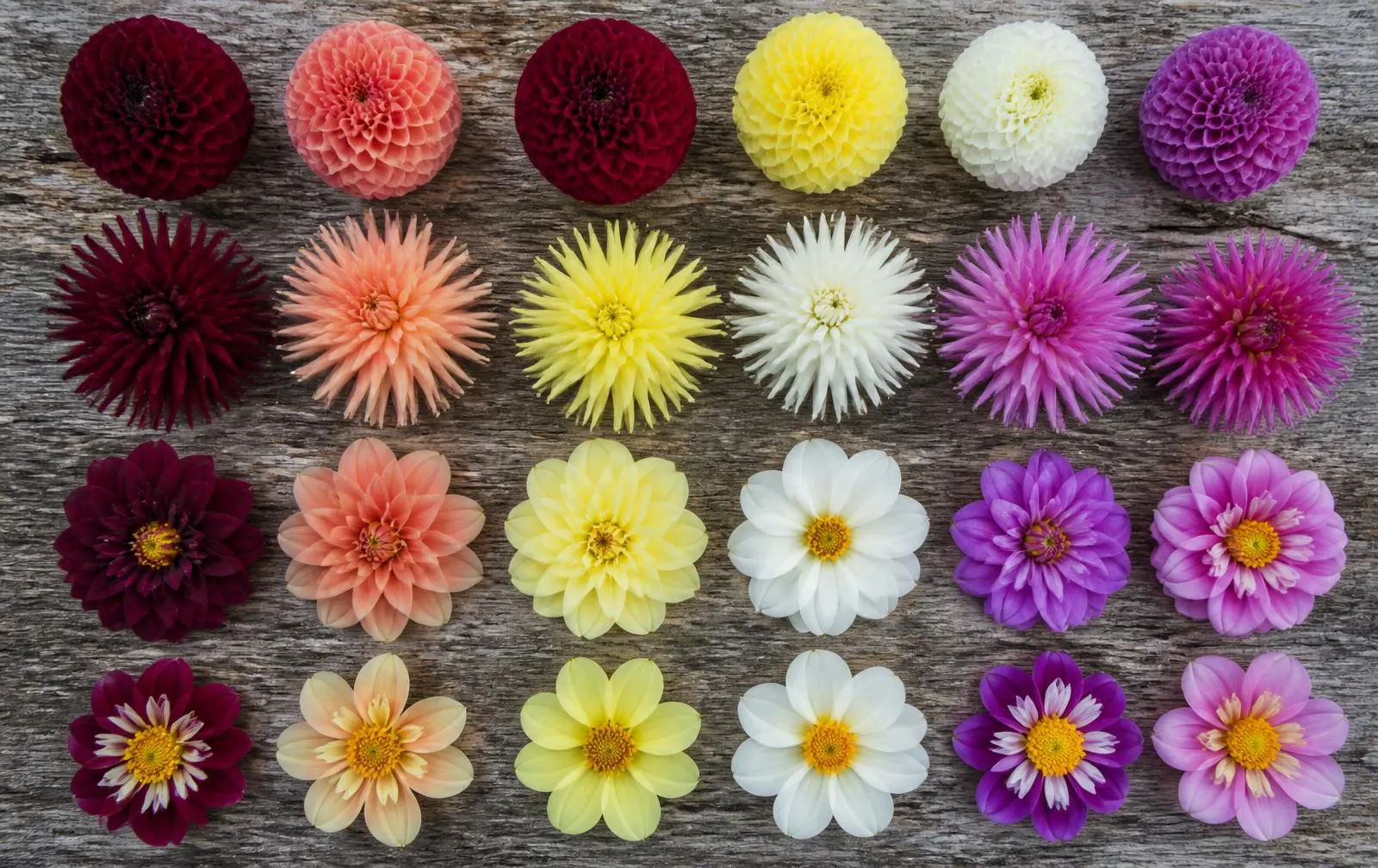
Flower form: the first thing a variety name tells you
Form describes petal shape and arrangement, and it matters more than color for how a dahlia behaves in a garden or a vase. The American Dahlia Society recognizes around twenty forms; these are the ones you will actually meet in catalogs.
| Code | Form | What it looks like | Best for |
|---|---|---|---|
| FD | Formal Decorative | Fully double, flat evenly-spaced petals in a regular pattern | Classic garden and vase flower; Thomas Edison is the archetype |
| ID | Informal Decorative | Fully double with irregular, twisting or curling petals | Most dinnerplates, including Café au Lait and Labyrinth |
| BA | Ball | Rounded, fully double with involute (rolled) petals | Long-lasting cut flower; excellent stem strength |
| MB / P | Miniature Ball & Pompon | Small spheres, pompons under 2 inches | Bouquet filler, market bunches, high stem counts |
| SC / IC | Semi-Cactus & Cactus | Pointed, rolled, spiky rays radiating from the center | Texture and drama; a strong contrast to round forms |
| WL | Waterlily | Shallow, few-rowed double with broad flat petals | Elegant, low-petal-count flower that opens like a nymphaea |
| CO | Collarette | Single ring of ray florets plus a short inner collar | Open center — very good for pollinators |
| AN | Anemone | Flat outer rays around a dense pincushion center | Unusual texture for mixed arrangements |
| S / MS | Single & Mignon Single | One row of rays around an open disc | Pollinator plantings, short bedding varieties |
| OR | Orchid & Orchette | Single with rolled or fluted rays | Airy, wild-looking stems for loose designs |
| PE | Peony | Two or more rows of rays with an open center | Soft romantic shape that still feeds bees |
| ST | Stellar | Fully double with rays curving inward toward the stem | Compact, tidy blooms with very good vase life |
| NX / LC | Novelty & Laciniated | Split, fringed or otherwise unclassifiable petals | Show classes and statement flowers |
| BB | Miniature / Small Formal-ish types | Under 4 inches across, decorative or ball form | Workhorse cut flowers with heavy production |
Size classes, from giant to pompon
Size is measured as bloom diameter and is the first half of the ADS code. It is the number that most often surprises new growers, because a "large" dahlia and a "small" dahlia differ by more than a factor of two.
| Class | Diameter | Notes |
|---|---|---|
| AA — Giant | Over 10 in | Show blooms; heavy disbudding required |
| A — Large | 8–10 in | The core of the dinnerplate group |
| B — Medium | 6–8 in | Big impact with better stems than AA |
| BB — Small | 4–6 in | Best all-round garden and market size |
| M — Miniature | Under 4 in | High stem counts, long vase life |
| BA / MB / P | Ball forms | Ball 3.5+ in, mini ball 2–3.5 in, pompon under 2 in |
If the giants are what drew you to dahlias in the first place, the dinnerplate dahlia guide covers the AA and A classes specifically — staking, disbudding and eight proven varieties.
Dahlia colors
The ADS recognizes fifteen color classifications, including blends and variegated patterns. One caution worth repeating: there is no true blue dahlia. Varieties sold as blue are lavender or purple, and photographs of vivid blue dahlias are edited.
| Color group | Representative varieties |
|---|---|
| White | Sandia Showstopper, Snowbound, My Love |
| Yellow | Kelvin Floodlight, Golden Scepter, Ferncliff Illusion |
| Orange / Bronze | Sylvia, David Howard, Bahama Mama |
| Pink | Otto's Thrill, Wine Eyed Jill, Linda's Baby |
| Dark Pink / Red | Karma Choc, Bishop of Llandaff, Cornel |
| Purple / Lavender | Thomas Edison, Blue Bayou, Night Silence |
| Blends & Bicolors | Labyrinth, Penhill Watermelon, Peaches n' Cream |
| Variegated / Tipped | Marble Ball, Sandia Brocade, Bumble Rumble |
| Dark / Near-black | Karma Choc, Rip City, Black Jack |
| Café / Antique tones | Café au Lait, Break Out, Wizard of Oz |
Color is also less fixed than catalogs suggest. Heat, soil and plant age all shift tone — Café au Lait can range from near-white to warm caramel on the same plant across a season, and Labyrinth swings between peach and raspberry depending on temperature.
Choosing varieties for your purpose
- Cutting garden: BB and B decoratives and ball types. Strong stems, heavy production, and the longest vase life of any dahlia group.
- Wedding and event work: A and AA informal decoratives in antique tones, supplemented with ball dahlias for structure.
- Pollinators: singles, collarettes, anemones and peony forms — anything with a visible open center.
- Containers and borders: mignon singles and dwarf bedding varieties under two feet, which need no staking.
- Showing: match the ADS classification exactly; a bloom entered in the wrong size or form class is disqualified regardless of quality.
Why varieties do not come from seed
Dahlias are octoploid, carrying eight sets of chromosomes, which makes them extraordinarily variable. Seed collected from a named variety produces seedlings that are genetically new — that is how every cultivar in this article originated, and it is why dahlia breeding is accessible to home growers. To reproduce a variety exactly, divide the tuber clump or root cuttings from a sprouting tuber.
Growing whatever you choose
Form and size change staking and spacing needs, but the growing calendar is the same across the genus: plant after frost in warm soil, pinch once, feed low-nitrogen, and lift before the ground freezes in zones 7 and colder. Start with the planting guide by zone, then the winter storage guide in the fall.
Common questions
How many dahlia varieties are there?
Tens of thousands of named cultivars, with several thousand in active trade. They are organized by form, size and color rather than by a master list.
What do the letters in a dahlia name mean?
A size class followed by a form code. "A ID" is a large, 8 to 10 inch informal decorative; "BB BA" is a small ball dahlia.
Which dahlia varieties are best for cutting?
BB and B decoratives and ball forms — the best balance of stem strength, stem count and vase life.
Which dahlias are best for pollinators?
Open-centered forms: single, collarette, anemone, peony and orchid.
Is there a blue dahlia?
No. Blue-marketed dahlias are lavender or purple, and blue photos are edited.
Keep your own variety records
Catalog descriptions are a starting point; your garden is the real data. The Dahlia Diary stores form, size class, hybridizer and a season-long photo timeline for every variety you grow, alongside your tuber inventory and bloom log.