Dahlia Diary
What a Dahlia Eye Looks Like (With Photos)
Every viable dahlia tuber has an "eye" — a small bump on the crown that sprouts next year's plant. If you can't find one, the tuber won't grow, no matter how plump it looks. Here's how to spot eyes confidently, even the tiny ones, before you divide or plant.

What is a dahlia eye?
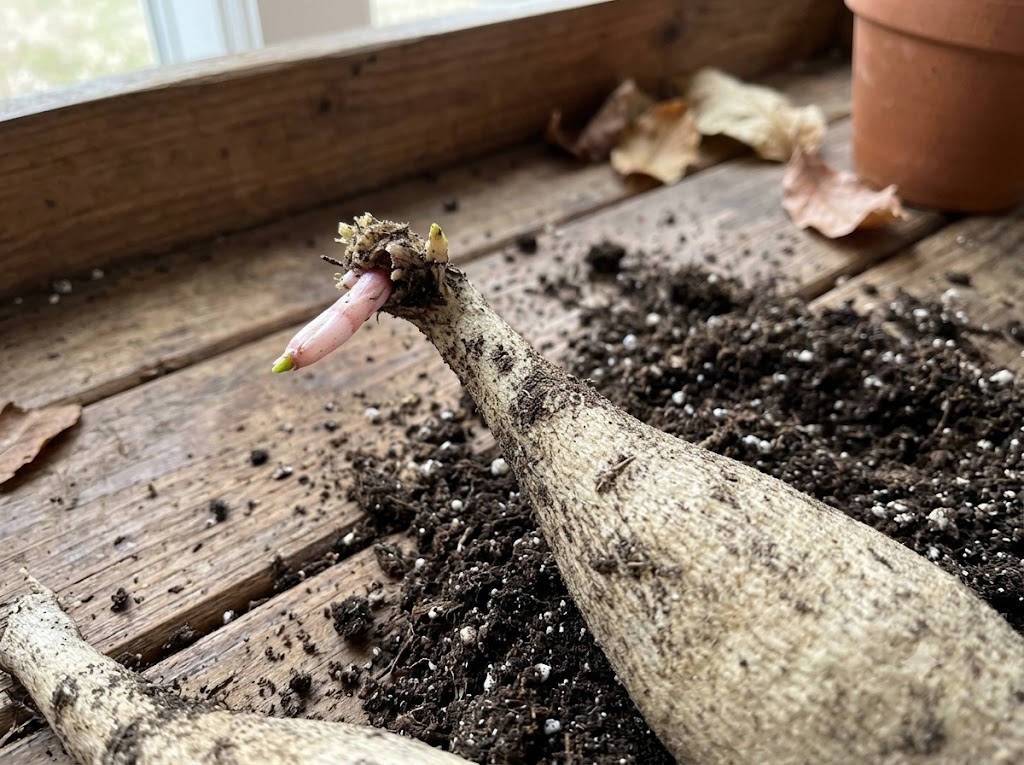
A dahlia eye is a growth point — the same idea as an eye on a potato. It's where next season's stem will emerge. Eyes start as small bumps and swell into rounded buds as growing conditions warm up. Once developed, they're often colored: green, pink, red, or purple depending on the variety.
Where dahlia eyes appear (the "collar")
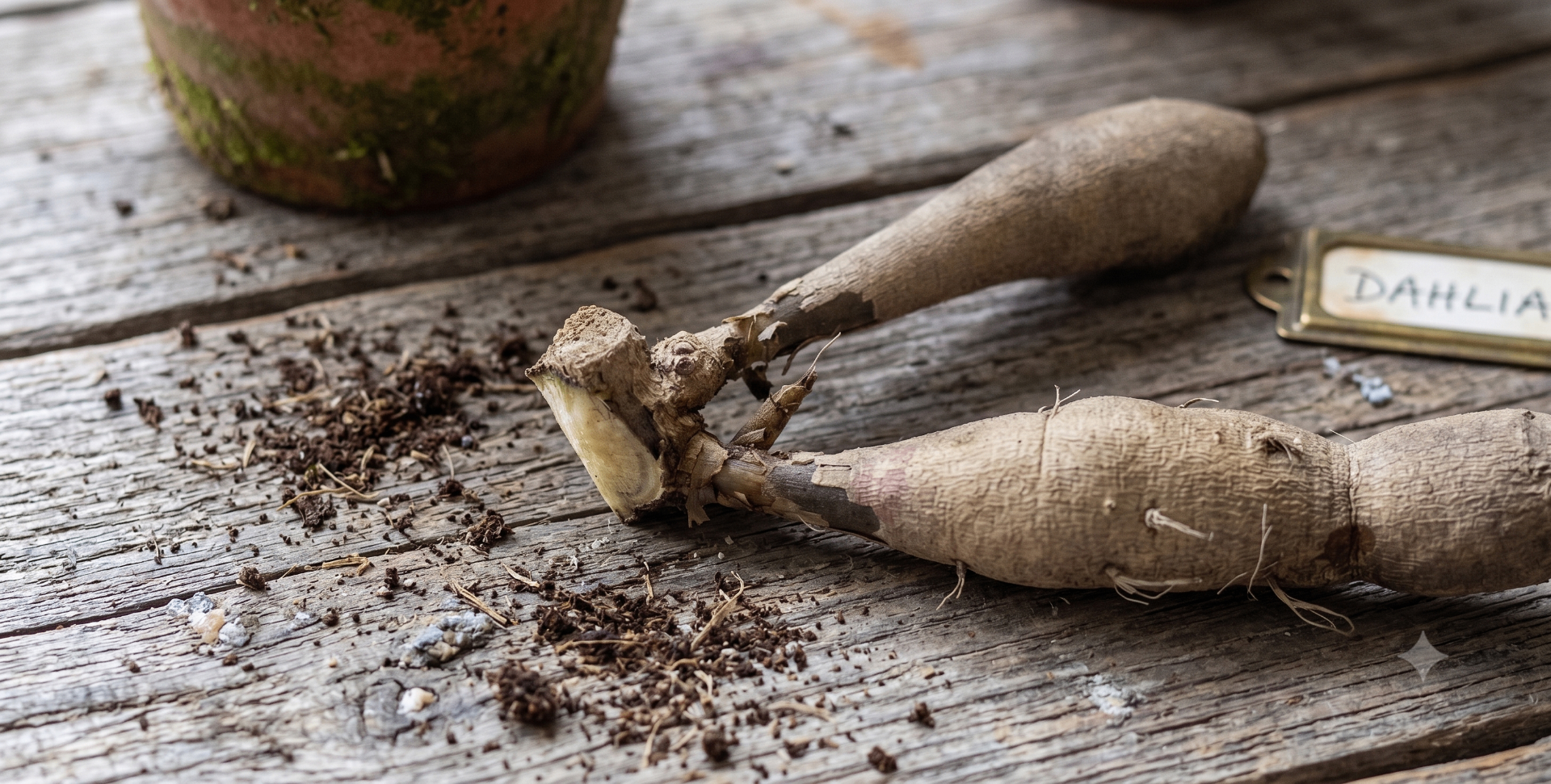
Unlike potatoes, dahlia tubers do not get eyes all over. Eyes only form in one place: the collar, which is the narrow band where the tuber joins the base of the old stem (the crown). Anywhere farther down the neck or on the tuber body itself will never sprout.
This is why dividing matters: every division must include a chunk of crown with at least one eye. A perfect-looking tuber snapped off below the collar is compost.


The obvious eye
Sometimes an eye is unmistakable — a swollen, colored bud pressed against the collar. Warmth and a little humidity in storage will activate eyes early, so by late winter many tubers show these clearly.
The pre-eye (the hard one to spot)
Most fall-dug tubers don't show swollen eyes yet. Instead they carry pre-eyes — tiny bumps that look like warts on the collar. They're easy to miss if you aren't specifically looking for them. Turn the tuber under bright light and scan just the collar band. A pre-eye is:
- Located only on the collar, never on the tuber body.
- Slightly raised, often paler or darker than the surrounding skin.
- Firm — not a soft blemish, scab, or damage mark.

When a tuber has no eyes (and never will)
If the tuber has broken off below the collar — no crown attached, just neck and body — it cannot grow. There's no active tissue left to produce a shoot. Some varieties also occasionally push an eye up onto the old stem itself; that's a bonus, not the rule.

How to divide dahlia tubers, step by step
Once you can spot the eyes, dividing is straightforward: every piece must keep a portion of crown with at least one eye. Use a sharp, clean knife or pruners and cut straight through the crown, not the tuber necks, so each finished piece still carries crown tissue with an eye.
- Rinse and dry the clump. Hose off the soil, shake out the water, and let the clump air-dry for an hour or two. Clean tubers make eyes visible; muddy ones hide them.
- Cut the old stem off flush. Trim the hollow stalk back to the crown so you can see the whole collar band. Hollow stems also trap water and cause crown rot in storage.
- Find the eyes before you cut anything. Turn the crown under bright side-light and mark each eye mentally — or with a pencil dot — so you know how many divisions the clump can yield.
- Split the clump in half through the crown. Start with a big cut down the center of the crown rather than nibbling at the edges. It gives you access and reduces broken necks.
- Cut individual divisions. Each keeper needs a wedge of crown with at least one eye, an unbroken neck, and a firm tuber body. Sanitize the blade between clumps (a 10% bleach dip or isopropyl wipe) so you don't spread virus.
- Discard the failures. Anything with no eye, a snapped neck, mushy tissue, or hollow rot goes in the compost — keeping them only takes up storage space.
- Cure the cut surfaces. Lay divisions in a single layer at room temperature for 24–48 hours so the cuts callus over, then label and pack them for storage.
Fall or spring? Fall division, a few days after digging, is easier on your hands — the crown is still soft and cuts like a carrot — and it saves storage space. Spring division is more forgiving for beginners because the eyes have swollen and are unmistakable, but the crown has hardened and needs a stronger blade. Either works; pick the one that matches how confident you feel finding eyes.
Practical tips for finding eyes
- Clean the collar first. Soil and dried skin hide small bumps. A soft brush and a rinse help.
- Use a bright side-light. Raking light casts shadows on bumps that flat overhead light hides.
- Use a magnifying glass for pre-eyes on small tubers — this is standard practice, not overkill.
- Wait a week if unsure. Moving suspect tubers to a warmer, slightly humid spot for 5–10 days often swells the eyes enough to confirm.
- Divide with the eye in view. Cut with the crown flat toward you so you can see exactly which piece gets which eye.
Still not sure? Pre-sprout to test viability
When you truly cannot tell, pot the tuber in barely-damp potting mix with the collar just at the surface, keep it at 65–70°F, and check in 2–3 weeks. A viable tuber will push a sprout. Note: once you wake a tuber up this way, you can't return it to cold storage — commit to planting it out at the right time.
Frequently asked questions
What does a dahlia eye look like?
A dahlia eye is a small raised bump on the collar — the narrow band where the tuber meets the old stem. Early in storage it looks like a pale wart or pimple; as it develops it swells into a rounded bud that is often green, pink, red, or purple depending on the variety.
Where are the eyes on a dahlia tuber?
Only on the collar or crown — never on the neck or the body of the tuber. Unlike potatoes, dahlia tubers cannot sprout from anywhere on their surface, so a tuber that snapped off below the collar will never grow.
How do you divide dahlia tubers?
Rinse and dry the clump, cut off the old stem, then find the eyes on the collar under bright light. With a sharp, sanitized knife, cut down through the crown so each piece keeps a chunk of crown with at least one eye plus an intact neck and tuber body. Discard any piece with no eye, a broken neck, or rot, then let the cut surfaces dry for 24–48 hours before storing.
When is the best time to divide dahlia tubers?
Either in fall a few days after digging, while the crown is soft and easy to cut, or in spring before planting, when the eyes have swollen and are easiest to see. Fall division saves storage space; spring division is more forgiving for beginners.
Can a dahlia tuber grow without an eye?
No. The eye is the only growth point, so a tuber with no eye and no crown tissue will never sprout — no matter how plump and healthy it looks. Compost it.
How many eyes should each division have?
At least one healthy eye. One eye is enough to produce a full plant; two or three are fine, but pieces carrying many eyes produce crowded, weaker stems.