Dahlia Diary
How to Save Dahlia Seeds: Harvest, Store & Grow
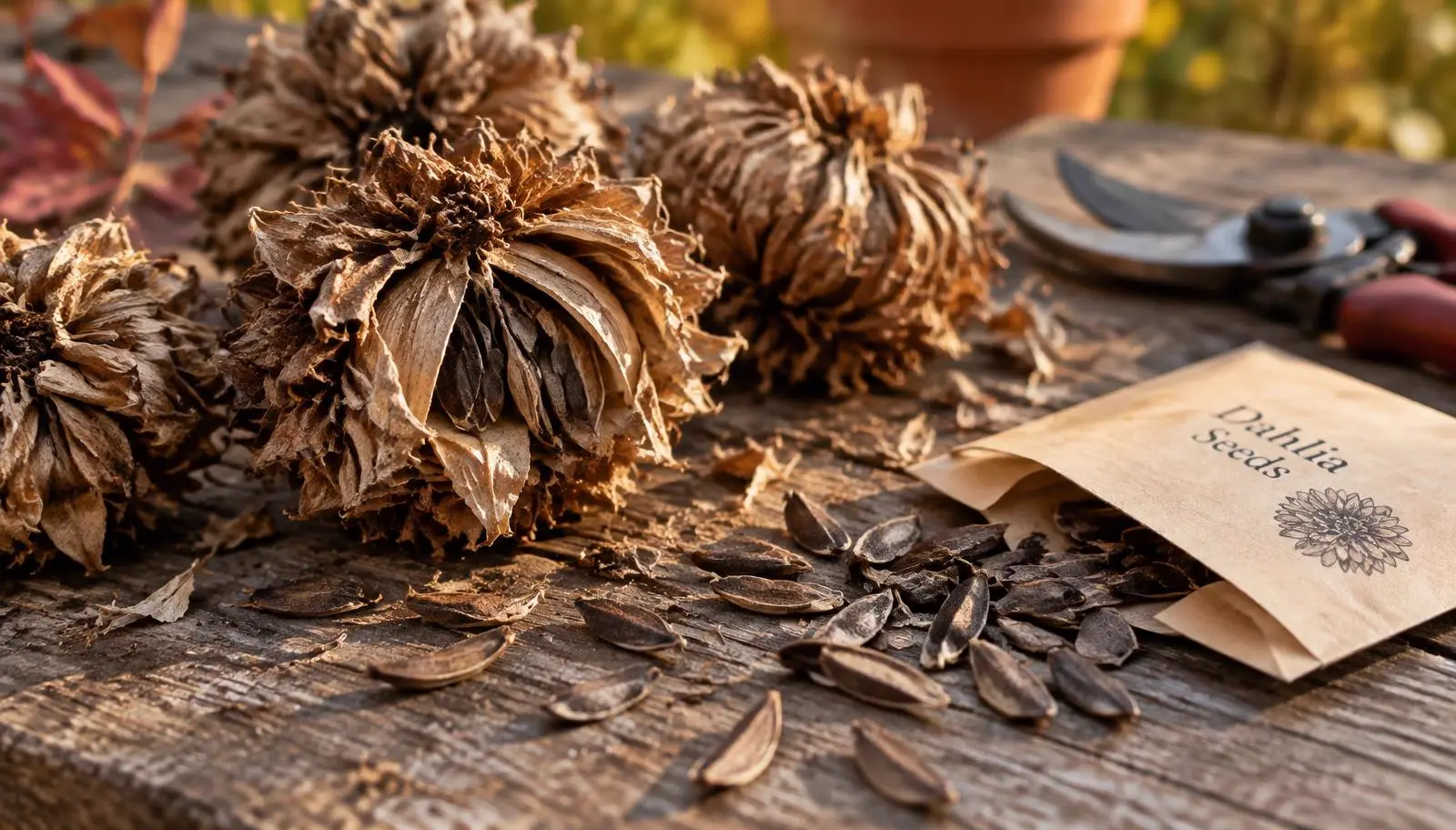
Saving dahlia seeds is not how you make more of a favorite variety — it's how brand-new dahlias get created. Every seed you collect is a genetic individual that has never existed before, and a handful of them may be worth keeping for years.
Why saving dahlia seeds is completely different from saving tubers
If you grow dahlias from tubers, you generally know what will bloom. Plant a tuber from a named variety and the new plant is genetically the same cultivar — that's why a stored tuber is the reliable way to keep a dahlia you love (see our step-by-step tuber storage guide).
Seed is another thing entirely. Plant 20 seeds from the same flower and you may eventually see 20 noticeably different dahlias. Colors change. Petal shapes change. Plants run taller or shorter. Flowers come single, semi-double, or fully double. Most seedlings will be ordinary, and occasionally one will be good enough that you keep it for years.
That unpredictability isn't a flaw — it's the entire point. Modern garden dahlias have unusually complicated genetics, with 64 chromosomes and commonly described as octoploid, which is one big reason offspring vary so much. Our deep dive on dahlia genetics, seeds, and propagation explains why no two seedlings come out the same.
Do dahlia seeds grow true to the parent plant?
Usually, no — and this is the most important thing to understand before you start.
Collect seed from a pink decorative dahlia and the seedlings aren't guaranteed to be pink, decorative, or even particularly similar to the mother plant. The flower you harvested from is the seed parent. In an open garden, the pollen almost certainly arrived on a bee from a different dahlia nearby, so you know one parent and usually not the other.
Dahlias also lean strongly toward outcrossing. The American Dahlia Society describes self-incompatibility in dahlias: pollen from the same plant is generally ineffective at fertilizing its own flowers, so successful seed usually comes from another dahlia's pollen.
So a packet labeled "seeds collected from Café au Lait" does not mean "seeds that will become Café au Lait." It means the mother was Café au Lait. If you want an exact copy of a named cultivar, propagate it from a tuber or a cutting instead.
Where dahlia seeds actually come from
What looks like one dahlia flower is really a collection of many small flowers called florets. Dahlias belong to the Asteraceae family alongside sunflowers, zinnias, and asters. Open-centered dahlias show visible disc florets in the middle, ringed by ray florets, and those fertile disc florets are where seed production happens.
That's why open-centered dahlias often set seed more readily than very full doubles: bees can easily reach the pollen and receptive florets, while a densely packed double hides its reproductive parts. Double dahlias absolutely can set seed — it's just less reliable in some cultivars. If flower form is new territory, our guide to dahlia forms, sizes, and colors lays out the differences.
One technicality: what gardeners call a dahlia "seed" is botanically an achene-like dry fruit containing the seed. For seed-saving purposes, calling it a seed is perfectly fine.
Fertilization happens earlier than you think
Seeds are fertilized while the flower is still functioning as a flower — not after the bloom has died. As florets mature, pollen becomes available and receptive stigmas emerge, pollinators do their work, and the seeds then develop inside the fading head.
So by the time a bloom looks brown and spent, the important work already happened. The weeks that follow are about letting those seeds finish maturing. This is exactly why cutting off a flower the moment its petals fade destroys a seed crop that was already underway.
When to stop deadheading dahlias for seed
Through most of the summer, deadheading is the right call — removing fading blooms keeps the plant flowering. When your goal shifts from flowers to seed, you have to stop removing at least a few blooms.
A good practical approach: pick the dahlias you want seed from and stop deadheading those specific flowers roughly four to six weeks before you expect your season to end. Dahlia societies commonly report that seed takes about four to six weeks to go from flower to mature seed, though weather, variety, and pollination all shift the timing.
You don't have to sacrifice the whole plant. Choose several promising blooms, tag them, and keep cutting the rest for the vase. Not sure when your season ends? Your frost dates drive all of this — check the planting calendar for your zone.
What a mature dahlia seed head looks like
This is the stage that causes the most confusion, so here's the progression to watch for.
| Stage | What the head looks like | What to do |
|---|---|---|
| Just after petals drop | Green, soft, moist, tightly closed | Far too early — the seed inside is still forming |
| 1–3 weeks later | Firming up, yellow-green, slightly loosening | Getting there, but leave it on the plant |
| 4–6 weeks after bloom | Tan to brown, firm, dry and papery, splaying open | Ready — harvest on a dry day |
Inside a ripe head, dahlia seeds are elongated and flattened — usually dark brown, gray-brown, or nearly black. Clemson Extension recommends collecting seed once heads have fully dried where possible, though a firm head holding mature seed can be harvested slightly early and finished indoors.
The biggest mistake is harvesting while the head is still very green, soft, and immature. Those contents may look like seeds, but the embryos never developed far enough to germinate.
Do seed heads have to stay on the plant until frost?
No. Frost isn't what makes dahlia seed viable — maturity is. If your heads are brown, dry, and mature before frost arrives, harvest them. Waiting only exposes them to autumn rain, mold, and decay.
If frost is closing in and a head is nearly mature but not quite dry, there's some flexibility: experienced growers routinely cut firm, developed heads and let them finish drying indoors. But drying can't rescue a seriously immature seed. Whenever weather allows, give seeds as much development time on the living plant as possible.
How to save dahlia seeds, step by step
1. Choose your seed parent
Save seed from healthy, vigorous plants with traits you actually want to see again:
- Flower color and interesting petal shape
- Plant vigor and strong stems
- Heavy flowering and disease tolerance
- Plant height and unusual foliage
- Good tuber production
The seedling may not reproduce any of these exactly. You're improving your odds, not placing an order. If you're leaning toward real breeding, also note which dahlias were growing nearby — they're your likely pollen parents.
2. Leave several flowers on the plant
Don't bet on one bloom. Not every flower gets successfully pollinated, and not every head holds mature seed. Leave several to develop, and tie a ribbon or plant tag on those stems so they don't end up in a bouquet by accident.
3. Let the flower fade naturally
Leave the spent bloom alone. Petals wilt, darken, and fall away, and the structure beneath develops into what gardeners call the seed pod or seed head. Patience matters much more than appearance here — a spent dahlia looks terrible long before the seed inside is finished.
4. Allow about four to six weeks
The exact time isn't fixed; temperature, rainfall, variety, and pollination timing all matter. Watch the head rather than the calendar. You want firm → tan → brown → dry, not soft and vividly green.
5. Harvest on a dry day
Cut the mature head with clean pruners, ideally after the dew has dried and never right after rain. Moisture is the enemy in storage, because damp plant material breeds mold. The RHS likewise recommends harvesting ripe seed on a dry day and drying heads thoroughly before storage.
Put harvested heads into a paper bag or open container — never a sealed plastic bag — and label immediately with the seed parent and the year, for example: Café au Lait — open pollinated — 2026. You may not know the pollen parent, but you still have valuable breeding information.
Cleaning seed out of the head
Once the head is completely dry, crumble it apart over a tray or sheet of paper. Most of what falls out won't be seed — expect dried petals, bracts, stems, and lightweight chaff. Look for pieces that are:
- Firm rather than paper-thin
- Elongated and relatively plump
- Brown, gray-brown, or nearly black
- Intact rather than shriveled
Dahlia seeds don't all look alike; size varies considerably with genetics and flower type. And a warning worth repeating: appearance alone can't guarantee viability. A good-looking seed can still fail to germinate, and that's normal.
Is the float test worth doing?
You'll see advice that viable seeds sink and empty ones float. It's a rough indication of whether a seed is filled, but seed density, trapped air, and seed-coat characteristics all affect floating — I wouldn't let it decide the fate of valuable seed.
A germination test tells you far more. If you have plenty of seed, sow a small sample and count: 14 out of 20 sprouting means roughly 70% germination for that lot, which is real information about the seed in your hand.
Drying and storing dahlia seed
The seed itself must be completely dry before it goes into long-term storage. After cleaning, spread seed in a single layer somewhere dry with good air circulation for several days. Avoid intense heat — the goal is drying, not cooking.
Once thoroughly dry, put the seed in a labeled paper envelope and keep it cool, dry, and dark. For longer storage, fully dried seed can go into an airtight container with a desiccant packet in the refrigerator; the RHS notes that storage around 41°F (5°C) extends viability for many properly dried seeds.
Moisture is far more dangerous than cold. Never seal damp dahlia seed in plastic or glass.
What to expect when you plant saved dahlia seed
This is where seed saving becomes addictive. Seedlings from the same mother can differ dramatically in color, bloom size, petal arrangement, centers, flower form, height, foliage, stem strength, and flowering habit. The RHS notes that seed-grown dahlias vary in both color and quality, which is why only the best seedlings are kept for propagation.
Treat your seedling patch as a selection garden, not a bed of identical plants. Some seedlings won't be attractive. Some will have weak stems. Some will be beautiful but poor cut flowers. And then one will stop you in your tracks — which is exactly why breeders grow hundreds or thousands of seedlings.
Why so many seed-grown dahlias have open centers
Open-centered flowers show up frequently among seedlings, especially when open-centered dahlias are well represented among the plants supplying pollen. There's a practical reason: those exposed disc florets are easy for bees to reach, and Clemson Extension observed substantially more pollinator activity on open-centered dahlias. Your garden's mix genuinely influences your results — though dahlia inheritance is complicated enough that predicting flower form from the parents is still guesswork.
Seed-starting temperature matters more than you'd expect
For most gardeners, the easiest approach is starting seed indoors about four to six weeks before your last expected frost, sown roughly ¼ inch deep in seed-starting medium kept evenly moist. Johnny's Selected Seeds reports germination in roughly three to five days at 65–70°F under good conditions.
But gardeners often assume a hot heat mat speeds things up. With dahlias, it can backfire. A 2026 peer-reviewed study of Dahlia variabilis tested germination across temperatures and found, after 21 days:
- 68°F (20°C): about 70% germination
- 77°F (25°C) with light: about 61%
- 77°F (25°C) in darkness: about 33%
- 86°F (30°C): 0% under the conditions tested
The researchers found dahlia seed combines a fairly hard surrounding fruit wall with physiological dormancy, with temperature influencing the hormonal pathways behind germination. The practical lesson: aim for the upper 60s to low 70s Fahrenheit, not a scorching mat.
Home-saved seed also germinates less uniformly than a commercial lot, so don't dump a tray just because everything hasn't sprouted at once.
Do fresh dahlia seeds need cold stratification?
For ordinary cultivated garden dahlias, no. Commercial growers germinate dahlia seed without chilling, and modern germination research shows success without stratification. There is evidence of dormancy and after-ripening within the genus — research on the wild species Dahlia coccinea found germination behavior changed as stored seed after-ripened — which may explain why home-collected seed sometimes comes up slowly or unevenly. But straightforward spring sowing is the right first approach.
Yes, a seedling can make tubers its first year
This is one of the most useful things about dahlias: a plant grown from seed forms tubers during its first growing season. Clemson Extension confirms those tubers can be stored and replanted the following spring.
That's how you preserve a special seedling. Say Seedling #27 throws a smoky peach flower on strong stems. Don't expect its seeds to reproduce it — instead:
- Label the plant clearly and photograph the bloom
- Dig its tubers at the end of the season
- Store them carefully (full storage walkthrough here)
- Check each division for a viable growth eye before replanting
- Replant next spring at the right time for your zone
Those tubers are vegetative copies of your selected seedling and will reproduce that same genetic individual — the moment a seedling becomes your dahlia. Worth remembering that dahlias are tender perennials, so in most zones that keeper only survives if you dig and store it.
Why didn't my dahlia produce any seed?
Opening a dried head and finding nothing is disappointing, but it isn't unusual. Common causes:
- The flower was never successfully pollinated. No fertilization, no seed.
- The flower form made pollination hard. Very full blooms hide their fertile florets.
- The head was harvested too early. Immature embryos can't finish inside an envelope.
- Cold or wet weather interrupted development.
- The cultivar has poor fertility. Not every dahlia sets seed well.
- The head rotted before the seed matured. Late rain plus dense heads is a bad combination.
The fix is almost always the same: leave multiple flowers on multiple plants.
A simple dahlia seed-saving timeline
| When | What to do |
|---|---|
| Late summer | Choose healthy plants and flowers you admire. Stop deadheading those selected blooms and tag the stems so nobody cuts them for a bouquet. |
| 4–6 weeks later | Watch the seed heads change from green and soft to firm, tan, and finally brown and papery. |
| Early to late fall | Harvest mature heads on a dry day, before persistent autumn rain causes rot. |
| After harvest | Finish drying heads indoors in a paper bag or open tray if they aren't bone dry. |
| Once fully dry | Crumble heads apart, separate seed from chaff, and let the cleaned seed dry a few more days. |
| Winter | Store labeled seed somewhere cool, dry, and dark. |
| 4–6 weeks before last frost | Start seeds indoors at moderate temperatures. |
| Summer | Evaluate your seedlings and mark the keepers. |
| Fall | Dig and store tubers from any seedling worth another season. |
How to label dahlia seed properly
If you think you might get serious about breeding, start good records right away. Instead of:
Pink dahlia seeds
write:
KA's Mocha Katie × open pollinated — 2026
or
Seedling 26-014 × open pollinated — 2026
You know which plant the seed came from, so record it. You don't know the pollen parent unless you deliberately controlled the cross — so don't guess. Over a few seasons you'll start noticing that certain parents repeatedly throw qualities you like. That's the moment seed saving turns into plant breeding.
Track your crosses and seedlings in Dahlia Diary
Dahlia Diary has a breeding log built for exactly this: record the seed parent, log each seedling with photos through the season, and carry your keepers into your tuber inventory for winter storage — so next spring you know precisely what you saved and why.
Set up your dahlia garden →Should you save seed from your very best dahlia?
Absolutely — but save both the tubers and the seeds, because they do different jobs:
- Tubers preserve the dahlia you already love.
- Seeds explore its genetics and produce something new.
Part gardening, part treasure hunt
Saving dahlia seed isn't the way to make more of a favorite named variety. It's something far more interesting: you're letting two complex genetic histories combine, then waiting months to see what they made.
Some seedlings will be disappointing. Some will be pretty but forgettable. Others will have gorgeous flowers on terrible stems. And once in a while you'll grow something genuinely special — genetically, there has never been another dahlia exactly like it. Give it a number, photograph it, record its traits, and save its tubers. It started as a seed hidden in one fading autumn flower, and it might become the dahlia you look forward to every year.
Frequently asked questions about saving dahlia seeds
Can I save seeds from any dahlia?
You can try. Some cultivars produce plentiful viable seed while others produce little or none. Open-centered dahlias generally give pollinators easier access than densely double forms.
Will seeds from a named dahlia produce the same variety?
No. Seedlings are genetically different plants. To reproduce a named dahlia faithfully, use tubers or cuttings.
How long does it take a dahlia seed pod to mature?
About four to six weeks after flowering is a useful guideline, but judge maturity by the seed head itself rather than the calendar.
What color are ripe dahlia seeds?
Generally brown, dark brown, gray-brown, or nearly black. Immature material is softer and greener. Color alone can't guarantee viability.
Should I harvest dahlia seeds before frost?
Yes, if they're mature. Frost isn't necessary for seed maturation.
Can I save a partly green seed head?
A firm, well-developed head close to maturity can sometimes finish drying indoors. Very immature, soft green heads are much less promising.
Do I need to refrigerate dahlia seeds?
Not if you're planting them next spring — they mainly need to be dry, cool, and dark. Refrigerated airtight storage helps for longer-term preservation.
Do dahlia seeds need cold stratification?
For ordinary cultivated garden dahlias, no. Straightforward spring sowing is the right first approach.
Will dahlia seeds flower the first year?
Yes. Seed-grown dahlias can flower and form tubers in their first growing season.
Are dahlia seedlings worth growing if most won't be perfect?
That's exactly the point. Every named dahlia exists because someone once grew seedlings and noticed one worth keeping.
Sources
This article was cross-checked against Clemson University Extension's dahlia seed-saving guidance, Royal Horticultural Society propagation and seed-storage resources, American Dahlia Society material on pollination and seed production, Johnny's Selected Seeds cultural information, Schie et al.'s molecular work on the polyploid genetics of garden dahlias, and Oo et al.'s 2026 controlled study of temperature and light effects on Dahlia variabilis seed germination.