Dahlia Diary
Dahlia Genetics, Seeds & Propagation: The Science
Every dahlia carries eight copies of its genome — which is exactly why a packet of seeds from your favorite cultivar never gives you back the same flower. Here is the science, in plain English, plus the three propagation methods that actually work.
Why dahlias are genetically wild
Most garden plants are diploid — two sets of chromosomes, one from each parent. The cultivated dahlia (Dahlia × variabilis) is octoploid: eight sets of chromosomes (2n = 8x = 64). That extra genetic baggage is the reason dahlias produce such an absurd range of forms, colors, and sizes — and the reason no two seedlings ever look alike.
When a diploid plant makes a seed, each parent contributes one of two possible chromosome copies. The math is simple. With eight copies in play, a single dahlia can shuffle thousands of allele combinations into every seed it sets. Cross two cultivars and you've effectively opened a slot machine — most pulls are ordinary, a few are spectacular, and exactly zero are identical to the parent.
Seeds vs. tubers vs. cuttings: what stays "true"
A named cultivar — 'Cafe au Lait', 'Linda's Baby', 'Cornel' — is a single genetic individual that was selected once and has been cloned ever since. To keep that exact flower, you have to clone it. Sexual reproduction (seeds) reshuffles the deck every time.
- Tuber division — clone. Genetically identical to the parent. Comes true.
- Stem cuttings — clone. Genetically identical. Comes true.
- Seeds — new genetic individual. Will not come true. Every seedling is its own unnamed variety.
If you've ever seen a dahlia labeled "seedling of Cafe au Lait" for sale, that's why — it's the child of a famous parent but a brand-new flower in its own right.
The anatomy of a dahlia bloom (briefly)
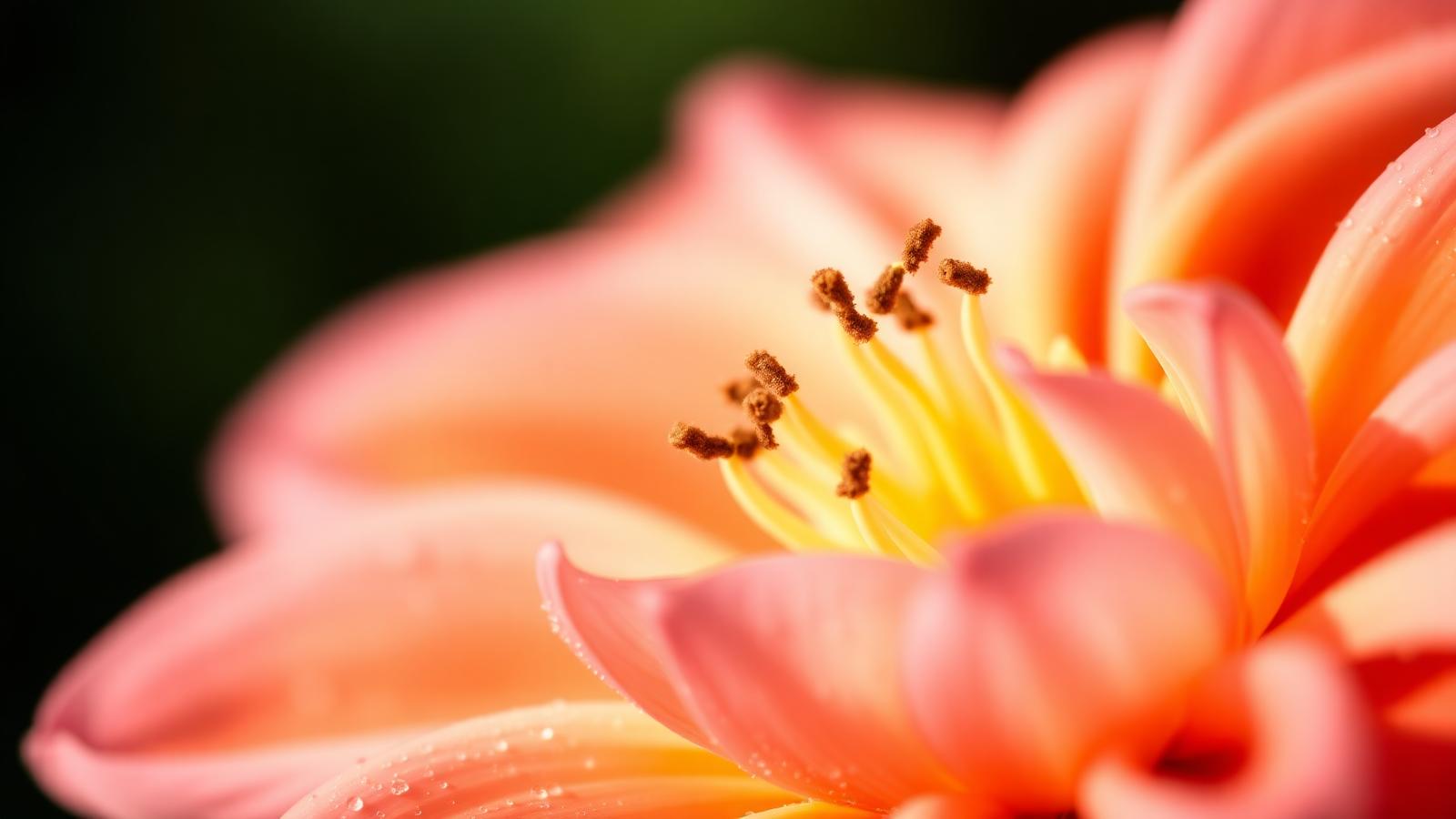
What looks like a single dahlia flower is actually a composite: hundreds of tiny florets packed into one head, like its cousins the sunflower and zinnia.
- Ray florets — the showy "petals" around the edge. Mostly sterile or female-only.
- Disc florets — the small tubular flowers in the center. These are the working florets, each with both male (stamens, pollen) and female (stigma) parts.
Pollination happens floret-by-floret in the center, opening in a spiral from the outside in over 5–10 days. Single-form and collarette dahlias have an exposed disc and breed easily; tightly-packed formal decoratives and ball forms hide the disc and are much harder to cross.
Hand pollination, step by step
Hand pollination lets you choose both parents — a controlled cross instead of leaving it to bees. The process is low-tech but requires patience.
- Pick parents. Choose a "seed parent" (the flower that will carry the seed head) and a "pollen parent." Open-centered forms work best for both roles.
- Isolate the seed parent. The day before the disc florets open, tie a piece of fine tulle or organza over the bloom to keep bees out.
- Collect pollen. On a dry mid-morning, tap the pollen parent's open disc florets over a small dish. Healthy pollen looks like bright yellow dust.
- Brush onto the stigma. Lift the tulle, dab a small artist's brush in the pollen, and gently brush the receptive stigmas in the center of the seed parent. Stigmas are receptive when their two forked tips have curled outward.
- Re-cover and label. Replace the tulle, tag the stem with seed parent × pollen parent and the date.
- Repeat for 4–6 days as new disc florets open. The seed head will swell and ripen over 4–6 weeks.
- Harvest before frost. When the back of the head turns papery and brown, cut it and dry indoors another 2–3 weeks. Crack open and separate the flat black seeds.
Realistic yield: a successful head produces 10–40 viable seeds. Of those, maybe one in 50 produces a flower worth keeping. Breeders sift through thousands of seedlings a year — patience is the entire game.
Growing dahlia seeds
Start seeds indoors 6–8 weeks before your last frost, like tomatoes. Sow shallow (¼"), keep at 70°F, and expect germination in 5–10 days. Pot up to 4" containers and harden off before transplanting. Most seedlings will bloom their first year and form a small tuber by fall — keep notes, photograph every bloom, and dig only the ones you'd grow again.
Tuber division: the easiest clone
A dahlia clump dug in fall is a cluster of tubers attached to a central crown. Each viable division needs three parts:
- A swollen tuber body (stores energy)
- A piece of crown tissue
- At least one visible eye — a small bump or pink dot on the crown that becomes next year's sprout
A tuber without an eye will never grow, no matter how plump it is. Wait 5–7 days after digging so necks toughen, then cut with a clean blade and dust cuts with cinnamon (a cheap, effective antifungal). A productive clump can yield 6–12 sellable divisions.
Stem cuttings: more plants from one tuber
Cuttings multiply a single tuber into 10–30 plants in a season. The science: dahlia stems contain undifferentiated cells at every node that will form roots when given moisture, warmth, and the auxin hormone (naturally present, boosted by rooting compounds like IBA).
- Pre-sprout the tuber in damp vermiculite at 65–70°F starting 6–8 weeks before last frost. Sprouts appear in 10–14 days.
- When a sprout has 2–3 sets of leaves and is 3–4" tall, cut it cleanly just above the crown with a scalpel. The mother tuber will produce another sprout from the same eye.
- Strip the lowest leaves, dip the cut end in rooting hormone, and stick into damp, sterile perlite or a 50/50 perlite-vermiculite mix.
- Keep humid (clear dome), warm (70°F bottom heat), and out of direct sun. Roots appear in 10–14 days.
- Pot up to 4" containers once roots are 1" long. Treat exactly like a seed-started plant from that point.
Cuttings are genetically identical to the parent tuber — the bloom will match exactly. They also tend to be more vigorous in their first year than divisions, since they put energy into roots instead of breaking dormancy.
What protects a named variety?
Some dahlias are patented or trademarked. A US plant patent (look for "PP#####" or "PPAF" on the label) gives the breeder exclusive rights to propagate and sell that cultivar for 20 years — you cannot legally divide and sell a patented tuber even from a plant you bought. A trademark (™ or ®) protects the name, not the plant itself. Most heritage dahlias have neither protection and are fair game to propagate, divide, and sell. Check the American Dahlia Society's classification database when in doubt.
Track your crosses in the Dahlia Diary
Every seedling deserves a parentage record — both parents, the cross date, and a photo of the first bloom. The BotaNotes Dahlia Diary includes a variety library, a bloom journal, and a tuber/cutting inventory so you can keep a multi-year breeding line straight without losing your mind. Future-you will be grateful.
Take the tour
Inside the Dahlia Diary
Scroll through three real screens — no sign-up required.
01 · Dashboard
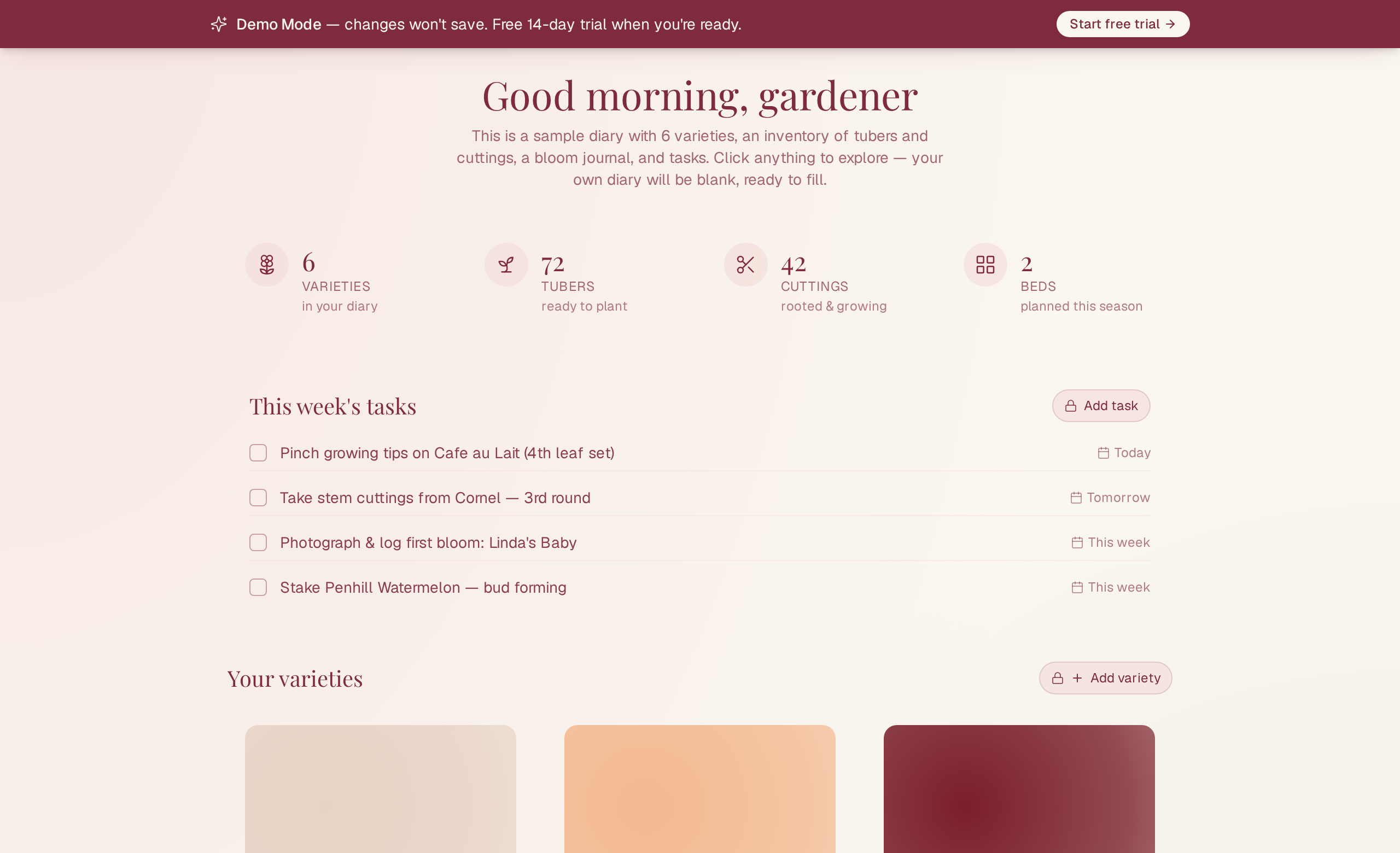
Open the diary, see your week
The home view surfaces this week's dahlia tasks — pinching, staking, disbudding — alongside the varieties currently in bloom. No spreadsheet hunting.
02 · Variety library
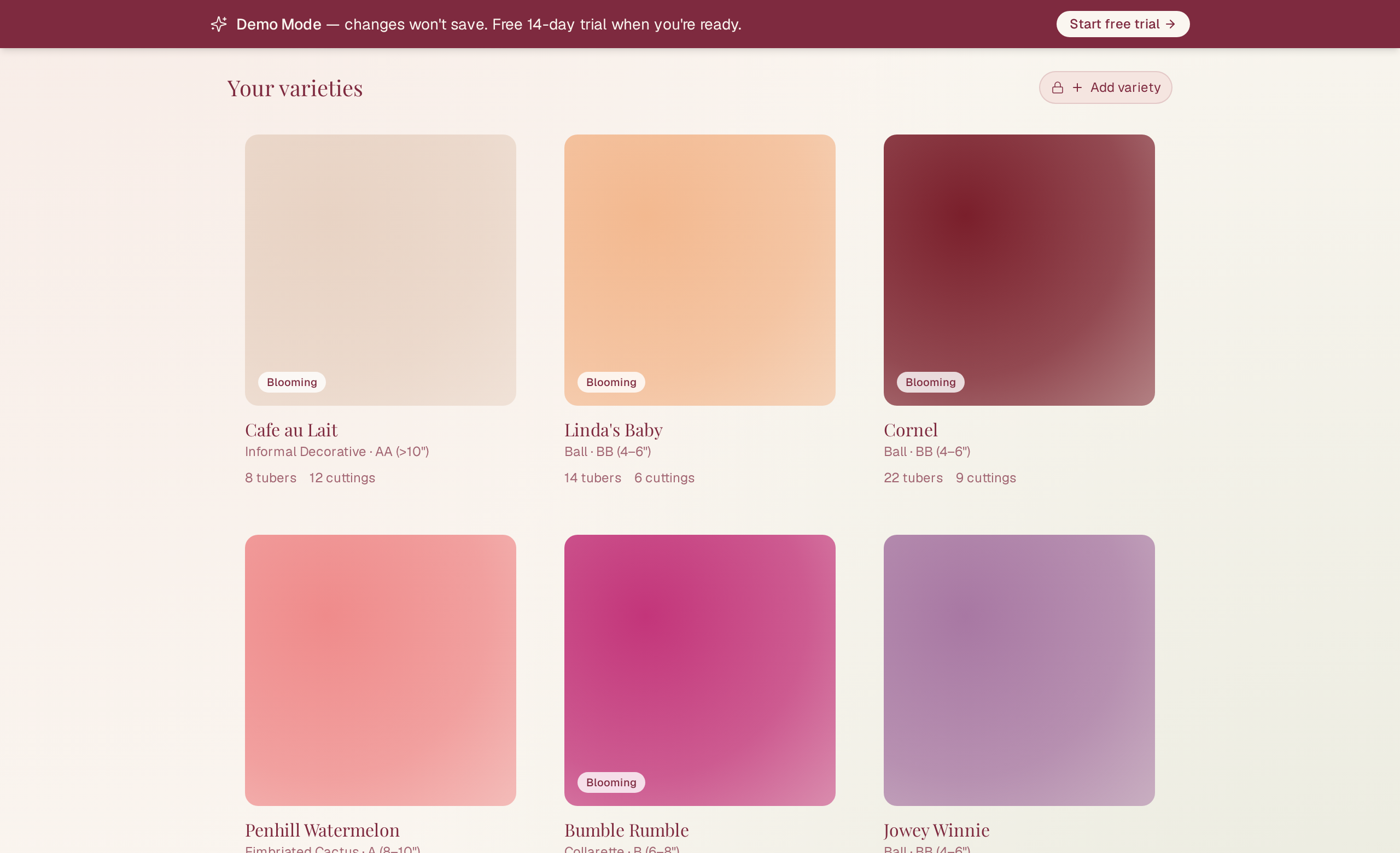
Every cultivar, with the facts that matter
ADS form, bloom size, plant height, color, and your own characteristics notes live on each card. AI-verified so you spend less time fact-checking catalogs.
03 · Bloom timeline
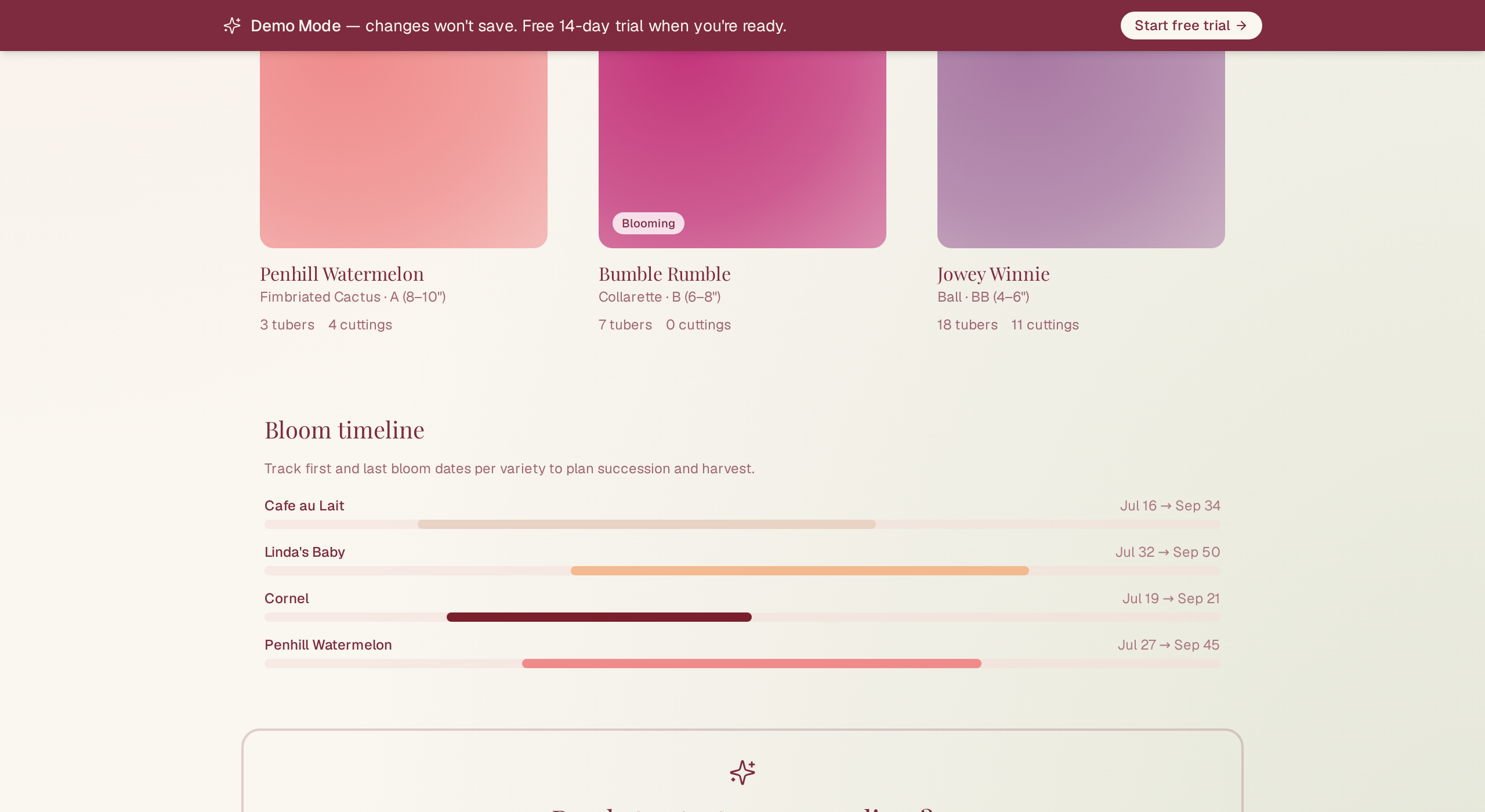
A season at a glance
Drag start and end markers per variety to map your real bloom window — then plan next year's succession from data, not memory.
Take a tour
See the Dahlia Diary in action
Read-only preview with sample varieties, bloom timeline, and inventory. No sign-up — start a free 15-day trial when you're ready to make it yours.