Dahlia Diary
Dinnerplate Dahlias: Best Varieties, Size & Growing Guide
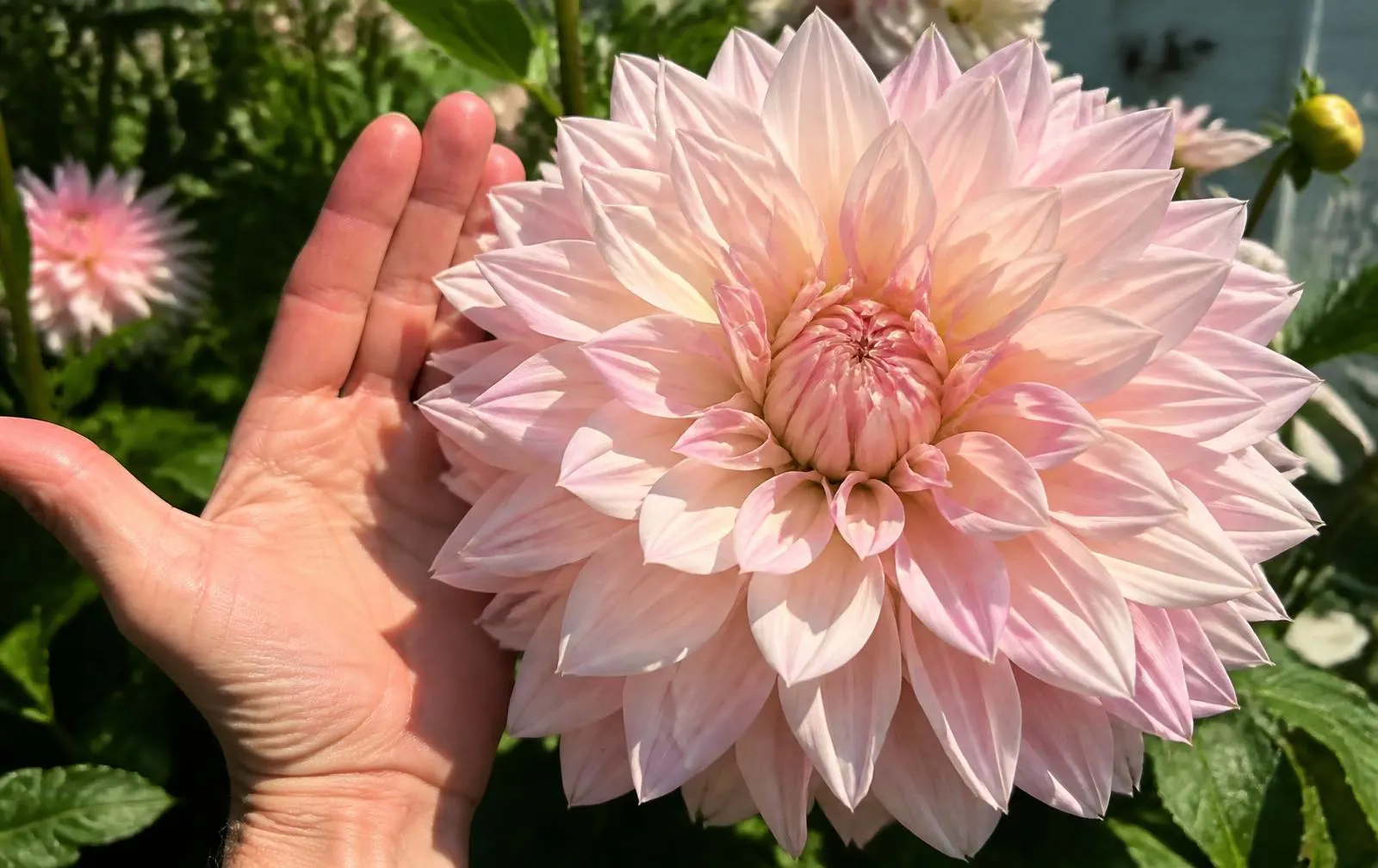
Dinnerplate dahlias are the giants of the dahlia world — blooms eight inches and wider on plants that can top four feet. They are not difficult, but they are demanding in three specific ways: support, feeding and disbudding.
What makes a dahlia a "dinnerplate"
Dinnerplate is a nursery term, not a botanical one. The American Dahlia Society classifies dahlias by bloom diameter: AA blooms exceed 10 inches, A blooms run 8 to 10 inches, and B blooms run 6 to 8 inches. Catalogs generally market the AA and A classes as dinnerplates, and many will include the larger B varieties too. If you want to know what you are actually buying, look past the word and find the size class and form code.
Almost every dinnerplate is a decorative dahlia — either informal decorative, with wavy, twisting petals, or formal decorative, with evenly spaced flat petals. Both give you the broad, full face that makes the flower read as a plate rather than a pom.
Eight dinnerplate dahlias worth growing
| Variety | Color | Bloom | Height | Notes |
|---|---|---|---|---|
| Café au Lait | Blush, cream and latte, shifting with temperature | 8–10 in | 3.5–4 ft | The wedding-industry standard. Color varies plant to plant and week to week. |
| Labyrinth | Peach, apricot and raspberry with darker reverses | 6–8 in | 3–4 ft | Twisting petals give the bloom depth that photographs unusually well. |
| Penhill Watermelon | Coral fading to soft peach and cream | 8–10 in | 4–5 ft | Informal decorative with long, relaxed petals. Tall — stake early. |
| Thomas Edison | Deep royal purple | 6–8 in | 3.5–4 ft | A heritage formal decorative introduced in the 1920s and still widely grown. |
| Kelvin Floodlight | Clear bright yellow | 10–12 in | 4 ft | One of the true giants. Heavy heads need substantial support. |
| Otto's Thrill | Soft pink | 8–10 in | 4 ft | Vigorous and productive — a reliable first dinnerplate for new growers. |
| Bloomquist Jean | Lavender-pink | 8–10 in | 4 ft | Strong, straight stems make it easier to cut than many dinnerplates. |
| Emory Paul | Deep rose-pink | 10–14 in | 4–5 ft | Frequently cited as one of the largest dahlias in cultivation. |
Two of these have full guides of their own: Café au Lait and Labyrinth. Sizes above are realistic garden expectations rather than show-bench records — a well-grown, heavily disbudded plant in rich soil can beat them.
Planting: timing, depth and spacing
Plant tubers once the soil has warmed to about 60°F and the danger of frost has passed. Cold, wet soil is the single most common cause of tuber rot, and a tuber planted two weeks early rarely flowers earlier than one planted at the right time. Our zone-by-zone planting guide gives specific windows.
- Lay the tuber horizontally, eye facing up, 4 to 6 inches deep.
- Space large varieties 18 to 24 inches apart.
- Drive the stake at planting time, not later — a stake driven in July spears tubers.
- Do not water at planting. Wait for the first shoot to break the surface.
If you are unsure whether a stored tuber will grow at all, check for a viable eye before it goes in the ground. Our guide on identifying an eye on a dahlia tuber shows exactly where they form on the crown.
Support is not optional
A mature dinnerplate plant is a four-foot column of hollow stem carrying flowers that can weigh several ounces each, and it gets heavier every time it rains. Use a hardwood stake, a T-post or a corral of twine strung between posts down a row. Tie loosely with soft twine in a figure eight every 12 to 18 inches. The failure mode to avoid is a stem snapping at the crown in an August storm, which usually ends that plant's season.
Pinch once, then disbud all season
When the plant reaches roughly 12 inches with three or four sets of leaves, pinch out the growing tip above a leaf pair. You lose two weeks of bloom and gain a bushier plant with many more stems. It feels wrong the first time and it is almost always the right call.
Disbudding is what actually produces dinnerplate-sized flowers. Each stem carries a central bud with two smaller side buds beneath it. Pinch off both side buds while they are pea-sized. The remaining flower is noticeably larger and sits on a long, straight, unbranched stem — the same technique cut-flower growers use to make dahlias saleable.
Feeding and water
Dahlias are heavy feeders but respond badly to nitrogen-rich fertilizer, which produces abundant soft foliage, weak stems and few flowers. Use a low-nitrogen formulation with higher phosphorus and potassium, roughly every three to four weeks from the time buds appear. Water deeply two or three times a week once the plants are established rather than lightly every day; shallow watering keeps the root zone at the surface and makes plants less storm-hardy.
Cutting and vase life
Cut in the early morning when the bloom is about three-quarters open and the petals on the back of the flower are still firm. Dahlias do not open after cutting, so a tight bud will simply stay tight. Strip the lower leaves, use clean water, recut the stems every two days, and expect four to six days from a large decorative. See our full post-harvest and vase-life guide for hydration solutions and handling.
Lifting and storage
After the first hard frost blackens the foliage, cut the stems back, wait a week or two for the eyes to set, then lift the clumps. Large dinnerplate varieties make correspondingly large clumps, which are easier to divide in the fall while the necks are still flexible. Our winter storage guide covers washing, curing, dividing and packing media.
Common questions
What is a dinnerplate dahlia?
A marketing term for dahlias with blooms roughly 8 inches across or larger, mostly in the ADS AA and A size classes and mostly informal or formal decorative in form.
How big do dinnerplate dahlias actually get?
Typically 8 to 10 inches in ordinary garden conditions. AA varieties such as Kelvin Floodlight and Emory Paul can pass 10 inches when disbudded and fed well.
Do dinnerplate dahlias need staking?
Yes — always, and the stake should go in at planting time so it does not damage the tuber later.
How do I get bigger dahlia blooms?
Disbud. Remove the two side buds on each stem so the plant puts everything into the central flower.
How far apart should dinnerplate dahlias be planted?
18 to 24 inches for large varieties, closer only in cut-flower rows with good airflow.
How long do dinnerplate dahlias last in a vase?
Roughly four to six days when cut three-quarters open in the morning into clean water.
When do dinnerplate dahlias bloom?
About 90 to 120 days after planting, so midsummer through first frost, with the biggest blooms in the cooler weeks of early fall.
Track your dinnerplates
Bloom size, stem length and color shift measurably from year to year and from plant to plant. The Dahlia Diary keeps a photo timeline, tuber inventory and bloom log per variety, so next spring you know which clumps actually earned their space.