Dahlia Diary
Labyrinth Dahlia: Complete Guide to Color, Size, Growing & Cut Flowers
Labyrinth is a large informal decorative dahlia whose twisting petals reveal shifting peach, apricot, coral and raspberry tones. Here is what growers can realistically expect from it in the garden and the vase.
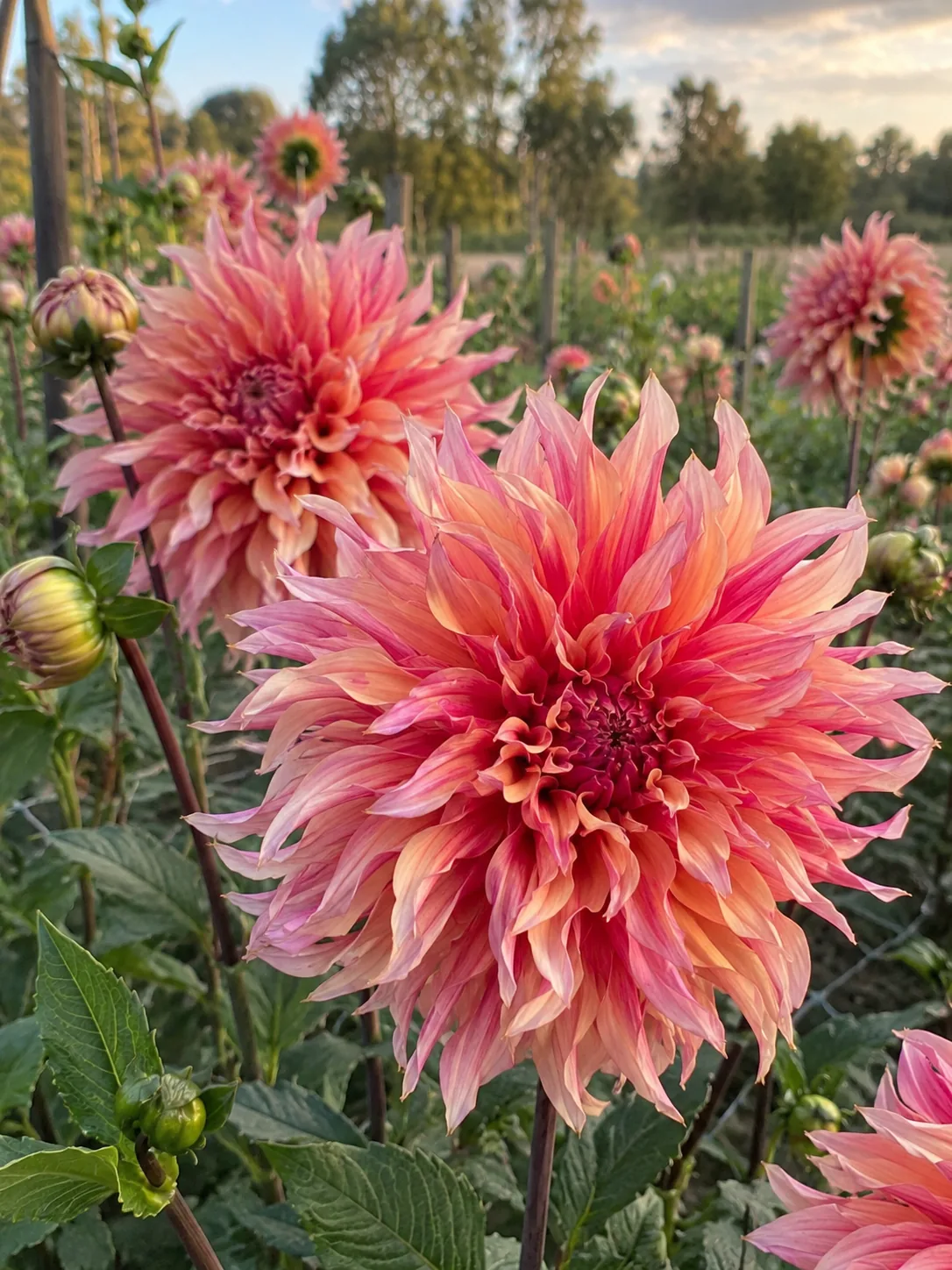
Few dahlias create movement quite like Labyrinth.
Its broad petals twist, curl and turn in different directions, exposing contrasting surfaces of peach, apricot, coral, rose and raspberry pink. The result is a flower that looks less like a perfectly constructed geometric dahlia and more like a watercolor painting caught in motion.
That distinctive form has helped make Dahlia ‘Labyrinth’ highly sought after by gardeners and cut-flower growers. Floret describes it as producing a remarkable number of large peachy-raspberry flowers on vigorous, dark-leaved plants, while Swan Island Dahlias compares its coloring to Café au Lait—but with deeper peach and pink tones.
Unlike many popular cultivars whose histories become muddled as information is copied from seller to seller, Labyrinth also has an unusually well-documented origin.
The official International Dahlia Register records Labyrinth as a 2013 introduction bred by A.C. Koot in the Netherlands.
Here is what we know about this extraordinary dahlia — and what growers should realistically expect from it in the garden and vase.
Labyrinth dahlia at a glance
| Characteristic | Labyrinth Dahlia |
|---|---|
| Cultivar | Dahlia 'Labyrinth' |
| Breeder / hybridizer | A.C. Koot |
| Country of origin | Netherlands |
| Introduced | 2013 |
| Original seedling number | Ariko 67-10 |
| Official RHS classification | Group 5 Decorative |
| Common U.S. description | Informal Decorative |
| Registered bloom size | 150 mm / about 5.9 inches |
| Common grower bloom size | Approximately 6–8 inches |
| Registered stem height | 0.9 m / about 35 inches |
| Typical mature height | Approximately 3–4 feet |
| Color | Peach, apricot, pink, coral and rose |
| Foliage | Dark green; described by Floret as dark-leaved |
| Bloom season | Midsummer through frost |
| Light | Full sun |
| Main uses | Cutting gardens, borders and floral design |
| Cut flower | Yes |
| Pollinator value | Low compared with open-centered dahlias |
| Winter behavior | Tender perennial |
The differences between the official registered measurements and commercial descriptions are worth noting. The International Dahlia Register records flowers at 150 mm, roughly 6 inches, while many modern growers report blooms around 6–8 inches. Floret lists Labyrinth in the 8–10-inch category, demonstrating how growing conditions and measurement methods can produce significantly different reported sizes.
What does a Labyrinth dahlia look like?
Labyrinth is defined as much by movement as by color.
The petals are broad but loosely arranged, with many curling, folding or twisting enough to reveal their darker undersides.
The RHS describes the flowers as large and flamboyant, with peach-colored petals that gently curl and twist to expose darker pink undersides.
That simple description actually reflects something much more complex.
The official cultivar registration uses precise Royal Horticultural Society color charts. The upper surface of the petals was recorded as light orange-yellow with strong red veins and a brilliant greenish-yellow base. The reverse was recorded as a combination of strong red and moderate pink with purple veins toward the tips.
In ordinary garden language, those colors appear as:
- peach
- apricot
- salmon
- coral
- warm pink
- raspberry pink
- antique rose
- occasional pale yellow near the petal bases
This is why photographs of Labyrinth can look dramatically different.
One bloom may be predominantly peach.
Another can appear pink.
Another may contain a stronger raspberry or coral cast.
Longfield Gardens describes the flowers as a watercolor blend of apricot, soft pink and old rose, while Summer Dreams Farm describes the cultivar as a blend of peach and coral.
All of these descriptions are compatible with the documented color structure of the flower.
The history of Labyrinth dahlia
Labyrinth has an exceptionally useful documented cultivar history.
According to the RHS International Register of Dahlia Names, Labyrinth was:
- Hybridized by: A.C. Koot
- Grown by: A.C. Koot
- Named by: P.J.M. van Schie
- Introduced by: P.J.M. van Schie
- Introduced: 2013
- Registered: 2013
- Original seedling number: Ariko 67-10
The registration also records a color-print nomenclatural standard supplied by the Dutch KAVB registration authority.
A separate KAVB registration record confirms A.C. Koot of Voorhout as the cultivar's breeder or “winner” and P.J.M. van Schie of Sassenheim as its registrant.
That makes the frequently repeated claim that Labyrinth is a Dutch cultivar introduced in 2013 well supported by primary registration evidence.
What type of dahlia is Labyrinth?
The RHS places Labyrinth in Group 5: Decorative Dahlias.
In the North American dahlia trade, it is usually described more specifically as an Informal Decorative, often abbreviated ID.
Floret lists Labyrinth as informal decorative, and its appearance fits the informal decorative description well: petals twist, curl and point in irregular directions rather than forming the highly ordered pattern characteristic of a formal decorative dahlia.
This loose arrangement is one of the reasons Labyrinth photographs so beautifully.
The flower has depth, shadows and movement even when viewed from directly in front.
Is Labyrinth a dinnerplate dahlia?
You will frequently see Labyrinth advertised as a dinnerplate dahlia, but this requires some explanation.
“Dinnerplate” is a garden and retail term rather than the cultivar's official RHS classification.
Labyrinth is officially a decorative dahlia.
Its original registration measured the flowers at 150 mm, or approximately 5.9 inches.
Modern growers report somewhat larger blooms.
Summer Dreams Farm reports approximately 6-inch flowers, while Swan Island lists 7-inch blooms. Floret places it in an 8–10-inch bloom category.
Those differences illustrate an important point: dahlia bloom size is not completely fixed.
Size may change with:
- climate
- soil fertility
- moisture
- plant maturity
- temperature
- number of stems
- disbudding
- overall plant vigor
So growers should think of Labyrinth as a large informal decorative dahlia, usually around 6–8 inches, with the potential for larger blooms under favorable growing conditions.
How tall does Labyrinth dahlia grow?
The original cultivar registration records stems reaching 0.9 meter, or approximately 35 inches.
Current growers commonly report somewhat taller mature plants.
Swan Island lists Labyrinth at approximately 4 feet, while Summer Dreams Farm reports approximately 46 inches.
The RHS broader plant profile lists mature height within approximately 1–1.5 meters, though its introductory description calls the plant approximately 90 cm tall.
For a U.S. home garden, a reasonable expectation is approximately 3–4 feet tall, with variation depending on growing conditions.
Labyrinth growing in the garden
Is Labyrinth a prolific bloomer?
There is particularly good grower evidence that Labyrinth can be productive.
Floret describes vigorous plants producing a very large number of flowers.
Summer Dreams Farm calls Labyrinth a very prolific bloomer and reports bushy plant growth.
These aren't controlled university yield trials, so it would be inappropriate to promise a specific number of stems per plant.
But independent commercial growers describing the cultivar similarly provides useful evidence that flower production is one of Labyrinth's strengths.
For someone deciding between large-flowered dahlias, that matters.
Some spectacular dinnerplate cultivars can be relatively stingy bloom producers.
Labyrinth appears to combine large blooms with comparatively good flower production.
Growing Labyrinth dahlia
Labyrinth follows standard dahlia culture but benefits particularly from sun, support, consistent moisture and regular harvesting.
Sunlight
Grow Labyrinth in full sun.
Swan Island recommends approximately 6–8 hours of direct sunlight, and the RHS specifies a full-sun, sheltered location.
In extremely hot regions, flowers may benefit from protection from the harshest late-afternoon heat, but inadequate sunlight generally results in weaker plants and fewer flowers.
Soil
The RHS recommends fertile, humus-rich, well-drained soil enriched with organic matter.
Drainage is particularly important when a tuber is first planted.
Before substantial roots and foliage develop, a dormant tuber sitting in cold, saturated soil can rot.
The ideal soil therefore combines moisture retention plus good drainage, rather than remaining either bone dry or waterlogged.
When to plant Labyrinth
Plant tubers outdoors after significant frost danger has passed and soil has warmed.
Rather than following a single national planting date, use local conditions.
Dahlia planting generally corresponds roughly with the time gardeners in an area would safely plant warm-season vegetables such as tomatoes.
Gardeners in warm southern regions may plant far earlier than growers in the northern United States. For a zone-by-zone breakdown, see our guide to when to plant dahlia tubers.
How far apart should Labyrinth dahlias be planted?
Recommendations vary somewhat among growers.
Floret uses 12–18-inch spacing for Labyrinth, while Longfield Gardens recommends approximately 18 inches.
For home gardeners wanting easier harvesting and better airflow, approximately 18 inches apart is a practical starting point.
Wider spacing may be useful in humid climates where additional airflow helps reduce foliar disease pressure.
Should you pinch Labyrinth dahlia?
Yes — particularly if you're growing it for cut flowers.
Floret recommends pinching Labyrinth when the plant reaches approximately 12 inches tall.
Pinching removes the central growing tip, which encourages the plant to develop multiple lateral branches.
For the cutting gardener, that generally means:
- more flowering stems
- better branching
- a bushier plant
- potentially longer useful stems
- more flowers over the season
If your sole goal is producing the largest possible individual bloom, you may instead manage the plant more selectively and disbud competing flower buds.
Should Labyrinth be staked?
Yes.
Even if the plant itself develops sturdy stems, its large flowers create considerable weight and wind resistance.
Swan Island describes the plant as strong and sturdy, but a four-foot plant carrying several 6–8-inch blooms can still be damaged during summer storms.
Useful support systems include:
- individual stakes
- tomato cages
- horizontal flower netting
- corral systems
- stakes with soft plant ties
Install support early so you don't accidentally drive a stake through the expanding tuber clump later in the season.
Watering Labyrinth dahlias
Once actively growing, dahlias appreciate consistent moisture.
Deep watering is generally preferable to repeated shallow watering.
During periods of heat and drought, large plants can move a surprising amount of water through their foliage and flowers.
At the same time, avoid keeping the soil permanently saturated.
The goal is even moisture in well-drained soil.
When does Labyrinth bloom?
The RHS records flowers appearing from midsummer through the first frost.
Floret gives approximately 80–100 days to maturity under its growing conditions.
That figure is useful for planning but should not be treated as an exact countdown for every climate.
Temperature, planting date, whether plants were started indoors, daylight and local growing conditions can shift first bloom considerably.
Once flowering begins, regular harvesting and deadheading encourage continued production.
Labyrinth as a cut flower
Labyrinth is particularly attractive for floral work because it combines:
- large bloom size
- unusual coloration
- romantic irregular form
- useful stems
- good productivity
- strong focal-flower presence
Both the RHS and multiple commercial growers specifically recommend it for cutting.
Floret also includes Labyrinth in its cut-flower library and provides specific harvest guidance for the cultivar.
There is, however, an important tradeoff.
Large informal decorative dahlias generally aren't the longest-lasting dahlia form in the vase.
The American Dahlia Society considers approximately five days in the customer's vase a desirable general target and notes that ball, formal decorative and pompon forms often possess characteristics particularly suited to cut-flower durability.
Labyrinth's strength is visual impact, not necessarily maximum longevity.
When should you harvest Labyrinth?
Floret recommends harvesting dahlias such as Labyrinth when flowers are approximately three-quarters open because dahlias do not continue opening substantially after cutting.
Check the reverse of the bloom.
You want outer petals that remain:
- firm
- hydrated
- lush
- flexible
Avoid flowers whose rear petals have begun becoming:
- papery
- limp
- browned
- dehydrated
The American Dahlia Society similarly advises harvesting cut dahlias while slightly immature — approximately one-half to three-quarters open — and cutting during cooler periods of the day when plants are well hydrated.
Immediately place stems in clean water.
How long does Labyrinth last in a vase?
There is no authoritative controlled cultivar-specific vase-life trial that justifies promising an exact number of days for Labyrinth.
That distinction is important.
The American Dahlia Society gives approximately five days as an ideal general customer vase-life target for cut dahlias.
Individual growers report varying results with large decorative dahlias.
Factors influencing vase life include:
- flower maturity
- temperature at harvest
- hydration
- stem quality
- bacterial levels in vase water
- flower age
- storage conditions
- room temperature
For the best result, harvest younger blooms, remove submerged foliage, use clean containers and keep arrangements away from direct sunlight and heat.
Longfield Gardens specifically notes that the heavy Labyrinth flower heads have high water demands and may sometimes benefit from hot-water conditioning when they wilt.
Labyrinth vs. Café au Lait
These two dahlias are often compared.
Swan Island explicitly describes Labyrinth as reminiscent of the famous Café au Lait but with deeper coloring.
The comparison makes sense.
Both offer:
- large decorative flowers
- romantic coloring
- irregular petal structure
- strong wedding-flower appeal
- excellent focal-flower potential
But visually they are quite different.
Café au Lait usually emphasizes cream, beige, champagne and blush.
Labyrinth usually emphasizes peach, apricot, coral, raspberry and rose.
Café au Lait feels softer and more neutral.
Labyrinth feels warmer and more saturated.
If Café au Lait resembles antique silk, Labyrinth resembles a watercolor sunset.
For floral designers, the two can also work beautifully together. For more on Café au Lait, see our Café au Lait growing guide, the dinnerplate dahlia guide for other large-flowered cultivars, or the full dahlia variety, form and color guide.
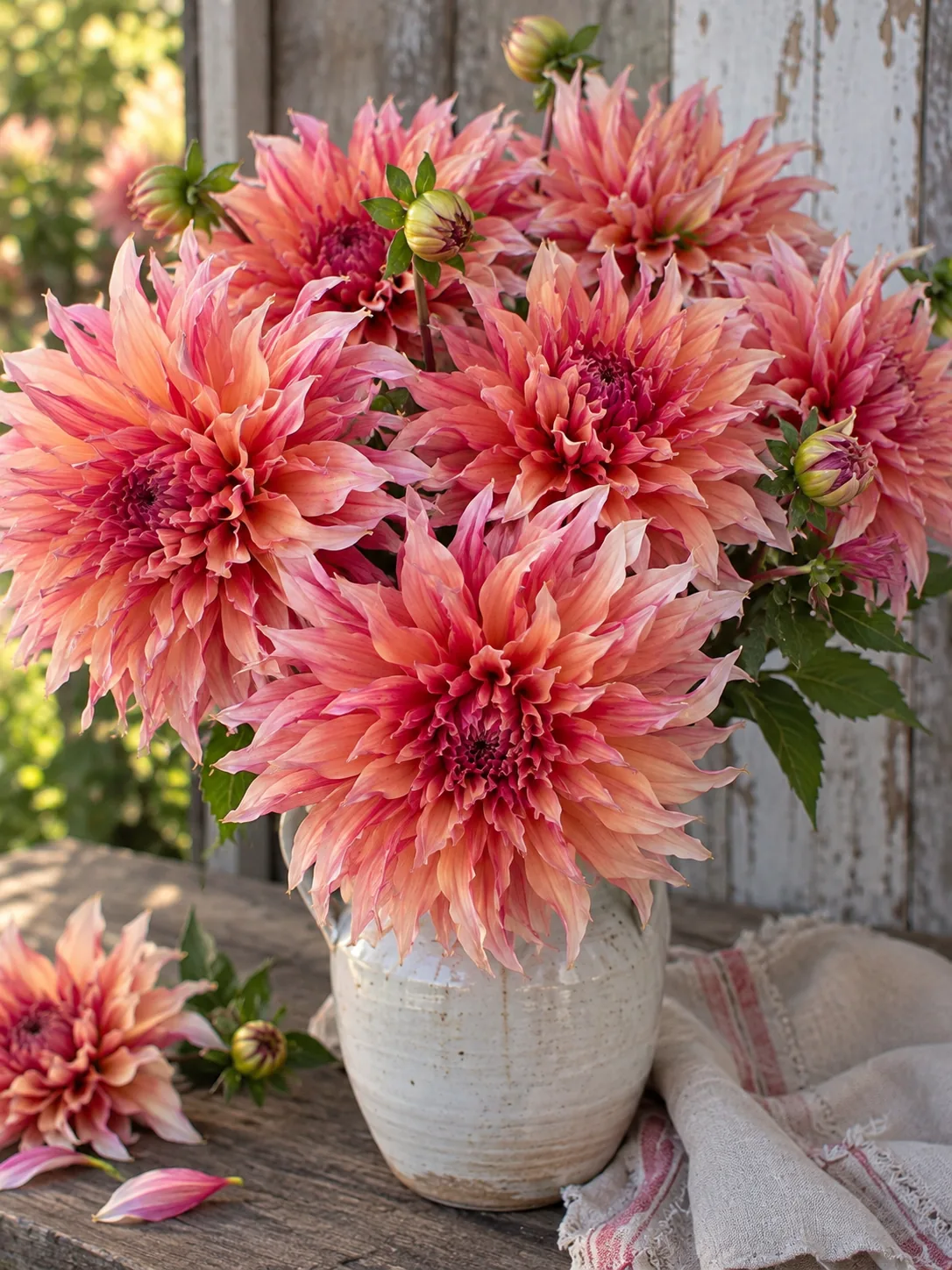
Designing a Labyrinth dahlia bouquet
Labyrinth has enough color complexity that it can inspire an entire bouquet palette.
Rather than surrounding it with equally large flowers, the most effective design is to allow Labyrinth to remain the clear focal flower and gradually step down through smaller supporting blooms.
The BotaNotes Labyrinth bouquet
For this arrangement, I would use a warm late-summer garden palette centered around peach, apricot, raspberry and burgundy.
Focal flower: Labyrinth dahlia. Use three large blooms with slightly different coloration — one predominantly peach, one peach-pink and one with stronger raspberry undertones.
Secondary flowers: apricot garden roses and antique blush zinnias. The roses repeat the soft peach coloring while providing a completely different rounded flower structure. Zinnias bridge the color transition between the roses and dahlias while adding smaller round forms.
Accent flowers: burgundy scabiosa and blush cosmos. Scabiosa echoes the raspberry-red petal reverses without overpowering the arrangement. Cosmos introduce delicate movement and open space around the enormous dahlia blooms.
Vertical flowers: cream snapdragons. Their upright flower spikes provide height and contrast with the rounded focal flowers.
Airy filler: ammi (false Queen Anne's lace) and bronze fennel. Fine white umbels soften the spaces between the larger flowers, while fennel provides movement and subtle bronze tones.
Foliage: burgundy ninebark and green basil foliage. Ninebark repeats Labyrinth's deeper red tones; fresh basil adds soft green foliage and a natural cutting-garden character.
Labyrinth bouquet recipe
For one medium-large garden arrangement:
- 3 Labyrinth dahlias
- 3 apricot garden roses
- 3–5 antique blush zinnias
- 3 burgundy scabiosa
- 3 pale blush cosmos stems
- 3 cream snapdragons
- 2–3 stems ammi
- 2 stems bronze fennel
- 2 stems burgundy ninebark
- 3 stems green basil foliage
The arrangement should remain loose and asymmetrical.
Some stems should arch beyond the main silhouette.
The dahlias should not all face directly forward.
The goal is to make the bouquet look freshly gathered rather than manufactured.
Why Labyrinth's color can change
As with many dahlias, color should not be viewed as completely static.
The Association of Specialty Cut Flower Growers notes that individual dahlia cultivars have a natural color range and that flower coloration can vary during different parts of the growing season.
Because Labyrinth already contains several pigments and contrasting petal surfaces, these changes can appear especially dramatic.
Possible appearances include:
- pale peach
- apricot
- coral
- salmon
- pink
- raspberry
- antique rose
Temperature, flower maturity and light conditions may all contribute to how we perceive individual blooms.
This also means buyers should be cautious when judging a cultivar from a single heavily edited product photograph.
Labyrinth's dark foliage
One trait that receives less attention than the flowers is the foliage.
Floret describes Labyrinth as producing its flowers on vigorous, dark-leaved plants.
That darker foliage helps intensify the warm flower colors in the garden.
It also means Labyrinth provides ornamental value even before the plant reaches peak bloom.
In mixed borders, the foliage works particularly well beside:
- cream flowers
- apricot flowers
- soft grasses
- burgundy foliage
- silver foliage
- pale pink annuals
Is Labyrinth good for pollinators?
Labyrinth is not among the best dahlias for pollinator access.
Its densely packed petals largely conceal the flower's reproductive structures.
The RHS specifically advises gardeners interested in pollinator-friendly dahlias to favor single-flowered forms, where pollen and nectar are much easier for insects to access.
That doesn't mean you shouldn't grow Labyrinth.
Instead, combine large decorative dahlias with open-centered flowers such as:
- single dahlias
- cosmos
- zinnias with exposed centers
- asters
- rudbeckia
- coneflowers
- herbs allowed to flower
That provides both cut flowers and pollinator resources.
Can Labyrinth grow in containers?
It can, but Labyrinth is not an especially small dahlia.
A mature plant may approach four feet and carry large, heavy flowers.
Use a substantial container with:
- excellent drainage
- enough soil volume to buffer moisture
- sturdy support
- full sun
- regular irrigation
- adequate fertility
Container-grown dahlias dry considerably faster than plants grown in the ground.
Do not choose a small decorative pot simply because the tuber itself looks small.
The eventual plant is much larger than the tuber suggests.
Labyrinth relatives: Red Labyrinth and Labyrinth Twotone
The Labyrinth name now extends beyond the original cultivar.
Two particularly interesting related cultivars are:
Red Labyrinth. The official RHS International Dahlia Register states that Red Labyrinth is a sport of Labyrinth. It was first propagated by P.J.M. van Schie and introduced and registered in 2019. Its flowers were recorded at up to 150 mm across with vivid red petals and a purple stem.
Labyrinth Twotone. Labyrinth Twotone is another mutation of the original Labyrinth. The Dutch KAVB registration describes it as a Labyrinth mutant displaying pale blue-violet and white coloration.
Both deserve individual Dahlia Diary profiles eventually because people searching those names are looking for distinct cultivars — not simply color variations of the original Labyrinth.
Is Labyrinth dahlia worth growing?
For gardeners who enjoy warm colors and dramatic flowers, Labyrinth is one of the more compelling modern decorative dahlias.
Its greatest strengths are:
- documented cultivar history
- unusual peach-and-raspberry coloration
- dramatic twisted petals
- large flowers
- strong cut-flower potential
- vigorous plant growth
- reports of prolific bloom production
- approximately 3–4-foot garden height
- excellent compatibility with wedding and floral-design palettes
Its disadvantages are typical of large decorative dahlias:
- flowers can be heavy
- plants need support
- vase life isn't as inherently durable as many ball dahlias
- blooms provide limited pollinator access
- individual flowers can vary noticeably in color
For the gardener who values individuality, however, that variability is an advantage.
No two Labyrinth flowers look quite identical.
Its peach upper petals, darker reverses and curling shape create a flower that seems to change as you walk around it.
And that may be Labyrinth's greatest appeal.
It isn't simply colorful.
It has movement.
Sources and further reading
This profile prioritizes cultivar-registration records and established horticultural organizations when available.
- Royal Horticultural Society — International Dahlia Register. The official cultivar registration documents record Labyrinth's hybridizer, introducer, date, seedling number, flower measurement, stem measurement and precise color description.
- KAVB — Dutch Cultivar Registration. The Dutch registration record independently confirms Labyrinth's breeder, registrant and color classification.
- Royal Horticultural Society — Dahlia ‘Labyrinth’ Plant Profile. Used for mature habit, flowering season, growing requirements, ornamental characteristics and recommended garden uses.
- Floret Flowers — Dahlia ‘Labyrinth’. Used for commercial grower observations regarding vigor, productivity, form, bloom-size range, spacing, pinching and harvest stage.
- Swan Island Dahlias — Labyrinth. Used for U.S. grower observations regarding flower size, mature height, coloration, plant strength and comparison with Café au Lait.
- American Dahlia Society — Cut Flower Guidance. Used for general cut-flower standards, harvesting stage and vase-life expectations.
- Association of Specialty Cut Flower Growers. Used for general commercial dahlia-production information and documentation of normal seasonal color variation in cultivars.